Carbon CMYK Box — Deep Colour
Carbon CMYK kit in production. Its complete composition is still being validated and it is not yet available to buy.
In production
This product is shown, but is not available to buy yet.
30-day satisfaction guarantee
Secure checkout via Shopify
Compose your workspace
The printing chain, step by step. What the boxed set contains is marked, the rest can be added — or ticked “I already have it”.
Complete workspace
1/5 steps
Format
01 · Chemistry — included in this boxed set
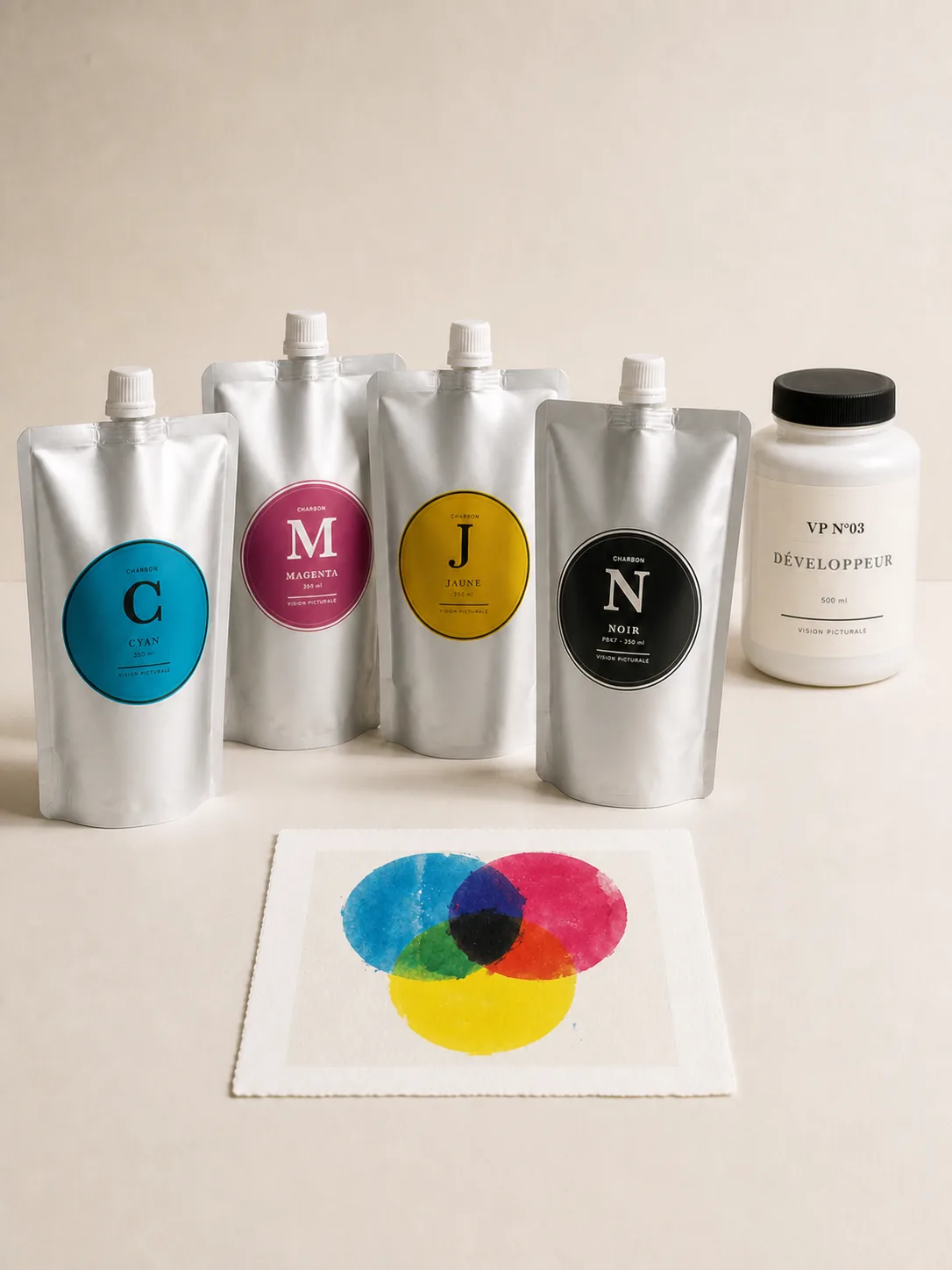
104 pouches of pre-sensitised mixture, 350 ml each, ready to pour — nothing to add.
Cyan — pouch C
Magenta — pouch M
Yellow — pouch J
- PBk7
Black — pouch N
- 500 ml
VP N°03 — Developer
- Coming soonComing soon
- Coming soonComing soon
- Coming soonComing soon
- Coming soonComing soon
- Coming soonComing soon
02 · Support
4- ——
- ——
- ——
- Coming soonComing soon
03 · Negative
1- ——
04 · UV exposure
1- ——
05 · Studio tools
1- ——
Selection total
€0
1 × Carbon CMYK
What you can create
Process guide
Find the steps, practical advice and safety information for this process in its dedicated guide.
Read the process guide
Calibration Flow
AppAnalyse your prints, calculate colour values and generate a correction curve (.acv) for more accurate negatives.
Carbon CMYK
Price to come
Compose your workspace
The printing chain, step by step. What the boxed set contains is marked, the rest can be added — or ticked “I already have it”.
Complete workspace
1/5 steps
Format
01 · Chemistry — included in this boxed set
104 pouches of pre-sensitised mixture, 350 ml each, ready to pour — nothing to add.
Cyan — pouch C
Magenta — pouch M
Yellow — pouch J
- PBk7
Black — pouch N
- 500 ml
VP N°03 — Developer
- Coming soonComing soon
- Coming soonComing soon
- Coming soonComing soon
- Coming soonComing soon
- Coming soonComing soon
02 · Support
4- ——
- ——
- ——
- Coming soonComing soon
03 · Negative
1- ——
04 · UV exposure
1- ——
05 · Studio tools
1- ——
Selection total
€0
1 × Carbon CMYK
What you can create
Need advice?
Our team can help you choose the right product for your project.
Process guide
Find the steps, practical advice and safety information for this process in its dedicated guide.
Read the process guideCalibration Flow
AppAnalyse your prints, calculate colour values and generate a correction curve (.acv) for more accurate negatives.
Learn more
Color carbon transfer extends Joseph Swan's 1864 invention through quadrichromatic CMYK separation, a technique developed in the early twentieth century to achieve permanent photographic color. Four pigmented gelatins, cyan, magenta, yellow and black, are exposed, developed and transferred successively onto the same 640 gsm cotton support. The result is often described as the Rolls of analog color: saturated hues, silky transitions, density comparable to the Carbon Mono — Museum Black. Unlike four-color Aquaprint which relies on gum arabic and remains time-sensitive, VP color carbon is the only multi-century archival color process in the catalog, designed to cross several generations without chromatic drift or pigment migration over time.
The kit supplies four gelatins pre-pigmented cyan, magenta, yellow and black, calibrated for consistent registration across the four successive passes. Each layer follows the standard cycle: exposure, contact with the transfer paper, warm water clearing at 40 °C, final transfer. No dichromate, contrary to historical carbon protocols, which makes the kit suitable for kitchen-safe practice without dedicated air extraction. Where four-color CMYK Aquaprint demands four gum layers and remains faster to execute, VP color carbon requires four precise transfers but offers in return a multi-century permanence that gum does not claim. It is the technical and heritage summit of the entire catalog.