The raw gesture
Gumoil allows applying oil pigments onto a photosensitized gum layer. Exposed areas harden and retain pigment, while unexposed areas remain soluble. The result is an image of incomparable organic quality.
Materials
Gelatin-coated watercolour paper 640 gsm · Gum arabic + sensitiser · Oil pigments
Working guidance
Read the safety information for each product, prepare your workspace and use the indicated protection before handling it.
The supports
What we print on
Every process is contact-printed on an absorbent support. PULPØ 900 gsm is the studio’s own — smooth, heavy, ready to use. Standard watercolour papers also work, once primed.
See the supports in the shop- PULPØ — 900 gsm · 25 × 35 cm (10 sheets)
- Ready to use, no primer needed. Smooth 900 gsm support in its actual 25 × 35 cm format.
- Watercolour Paper 300 gsm — A4
- The everyday weight. Universal Primer is required.
- Watercolour Paper 640 gsm — A4
- The heavy weight, no cockling. Universal Primer is required.
- VP N°04 — Universal Primer
- Required with 300 and 640 gsm watercolour papers. Mark “I already have it” if you own some.
Makes watercolour papers usable
In 4 steps
Make a Gumoil in 4 steps
Prepare
Sensitize the gelatin paper with the sensitizer mixed with gum arabic.
Calibrate
Print your negative on transparent film with the gumoil ICC profiles.
Expose
Expose with the Luminograph, then wash away unhardened areas.
Reveal
Apply oil pigments with a pad or roller onto the hardened gum.
Gumoil vs Bromoil
Gumoil or Bromoil: which process to choose for your intent
Gumoil and Bromoil are often confused because they share the idea of applying ink or oily pigment onto a photosensitive matrix. But their matrix, their gesture and their rendering are radically different — and the choice depends on what you want to express.
Bromoil starts from a thick, smooth gelatin. The pigment is Charbonnel intaglio ink, very fluid, applied with a foam roller. The rendering is soft, continuous, close to lithography. Ideal for portraits, still life, images demanding subtle tonal modulation.
Gumoil starts from a matte, slightly granular gum arabic. The pigments are thick oils applied with a pad or hard roller. The rendering is textured, raw, almost pictorial — much closer to engraving or oil painting than to photography. Ideal for landscapes, architecture, images that want to embrace their materiality.
In a sentence: Bromoil seeks grace, Gumoil seeks gesture. If you come from traditional photography and want to extend it toward the pictorial, start with Bromoil. If you come from drawing, engraving or painting and want to integrate the photographic image, start with Gumoil. Many artists end up practicing both.
Frequently asked questions
Everything about this process
What is the origin of Gumoil?
Gumoil is a pigment process developed in the 1990s by American photographer Karl Koenig, who published its detailed formulation in his book Gumoil Photographic Printing released in 1994. Gumoil combines the logic of pictorialist gum bichromate with oil inking: ground oil pigments are incorporated directly INTO gum arabic before exposure, unlike Aquaprint where the pigment already arrives dispersed in the gum of the pouch. Gumoil Vision Picturale removes the dichromate from Koenig's historic formulations by using Universal Sensitizer on gum, mixed with ground oil pigments. The rendering sits between engraving and photography, with raw pigment carrying the image without intermediate dye.
What are the steps of a Gumoil print?
A Gumoil Vision Picturale print follows a five-step sequence without aqueous clearing. The practitioner prepares a mixture of gum sensitized with Sensitizer, into which oil pigments are ground at the desired dosage, generally fifteen to twenty-five percent by mass. The layer is applied with a flat brush onto 640 gsm 100% cotton watercolor paper and dried for thirty minutes in darkness. Exposure under a 395-400 nm Luminograph A4 unit lasts two to five minutes depending on negative density. Reveal occurs through selective adhesion: a soft pad removes pigment from unexposed zones while UV-hardened pigment remains fixed on exposed zones. No clearing in warm water at 40°C, unlike Aquaprint. Final drying takes twenty-four hours.
How does Gumoil differ from Aquaprint?
Gumoil and Aquaprint Vision Picturale share gum and Universal Sensitizer, but differ radically in pigment and reveal. Aquaprint uses mineral pigments already dispersed in the aqueous gum of the pouch, revealed by clearing in warm water at 40°C which dissolves unexposed gum. Gumoil incorporates ground oil pigments into the same gum, revealed without water by selective adhesion with pad or foam roller. Aquaprint allows CMYK four-color printing in four successive layers; Gumoil remains practically limited to monochrome or bichromic work. The practitioner will choose Gumoil for contrasted graphic images with matter-rich rendering, and Aquaprint for nuanced and faithful color images.
What skill level does Gumoil require?
Gumoil Vision Picturale is an advanced-level process, recommended after solid mastery of monochrome and four-color Aquaprint. The difficulty lies in dosing oil pigment within gum sensitised with Universal Sensitizer, which must stay between fifteen and twenty-five percent by mass: too little, the image lacks density; too much, adhesion reveal becomes impossible. Controlling pressure and speed of the pad or roller during reveal demands manual practice comparable to printmaking. In addition to the kit (gum + sensitizer), the practitioner must acquire extra-fine artist oil pigments from brands such as Sennelier or Old Holland, a frosted glass grinding plate, a grinding knife, and a high-density foam pad.
How permanent is a Gumoil print?
A Gumoil Vision Picturale print presents a stability estimated at several centuries, conditioned by the quality of the oil pigments selected. Oil pigments ground in polymerized linseed oil binder form, after complete drying of several weeks, an insoluble and chemically inert film, comparable to classic oil paintings whose multi-century stability is documented in the Louvre and Rijksmuseum collections. gum arabic hardened by Sensitizer is as stable as historic gum bichromates. The practitioner must imperatively use pigments rated ASTM I, avoiding organic lakes. Complete final drying takes three to four weeks at room temperature, during which the print must not be stacked or framed under glass.
Chemistry kit
Gumoil
Gumoil combines gum and raw pigments for an organic rendering between engraving and photography. Pigment adheres to gum areas hardened by UV light, creating images with rich texture and raw character.
An alternative
Want a Gumoil, not make it yourself?
Gumoil is a process of pad and pressure: each print carries the trace of the hand that made it. The printers of Maison Picturale make this their signature. Prints made in Paris, on 640 gsm gelatin-coated cotton paper, natural oil pigments.
Order a Gumoil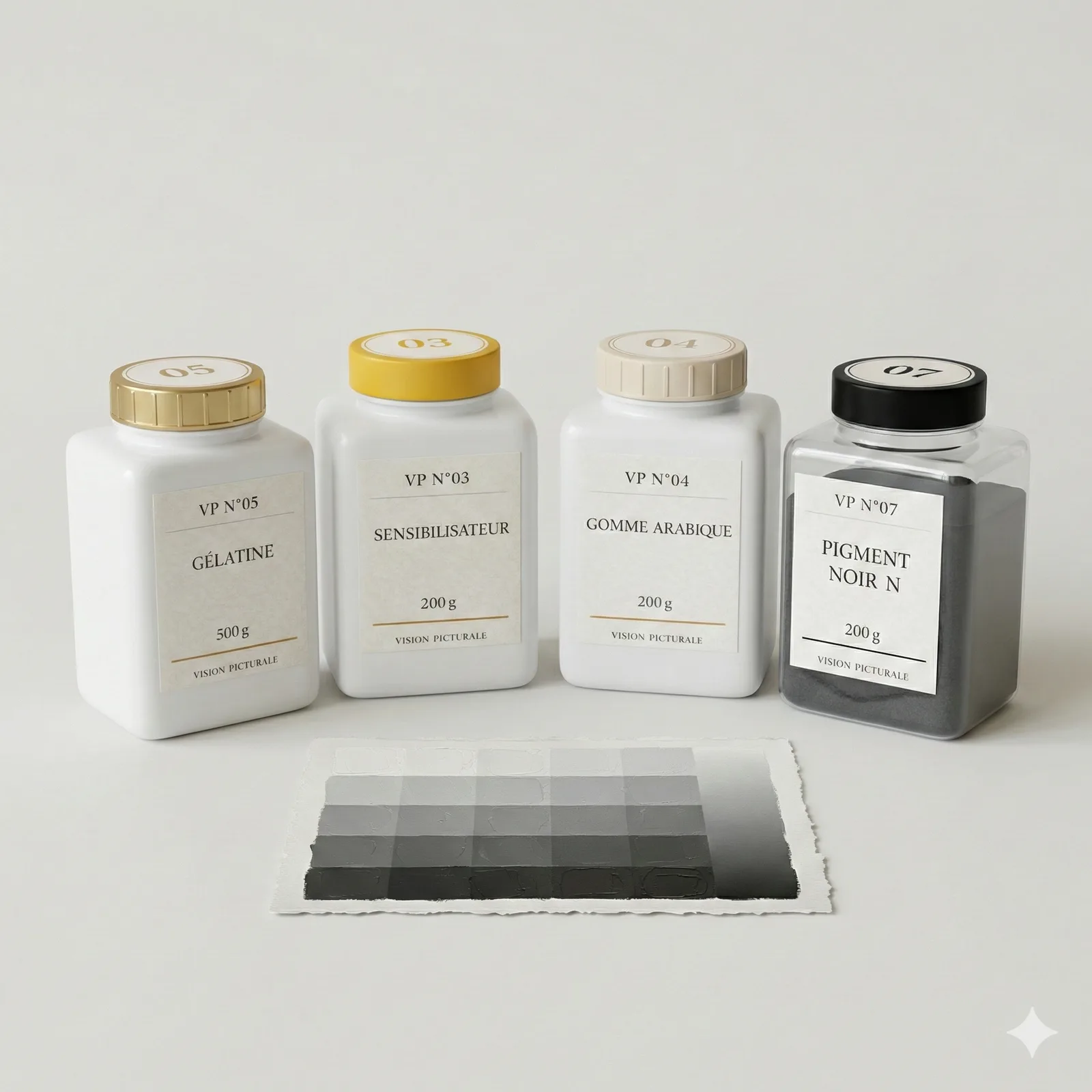
Maison Picturale · Paris 20e