Alternative process
AdvancedGum Print Monochrome
Deep black, watercolour softness
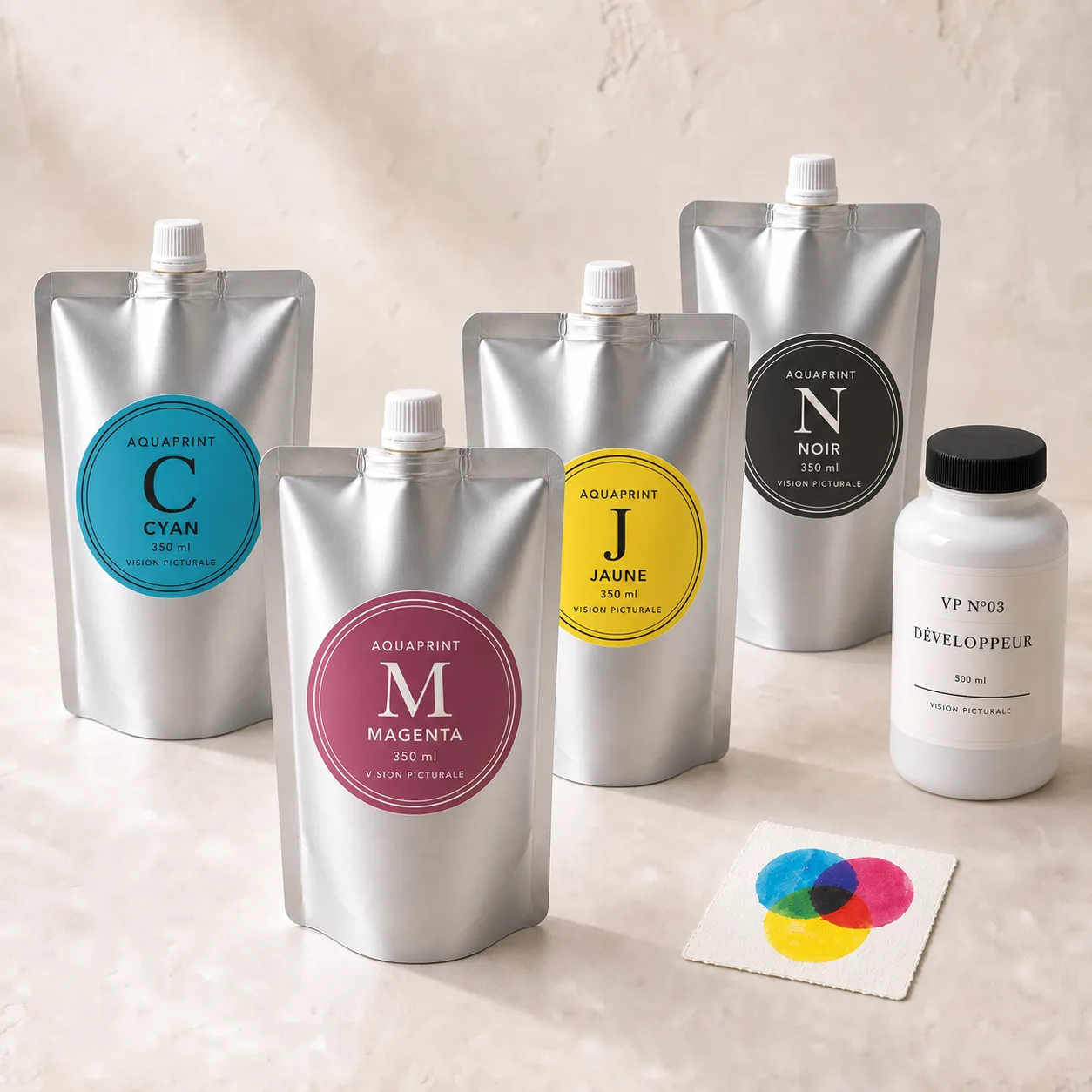
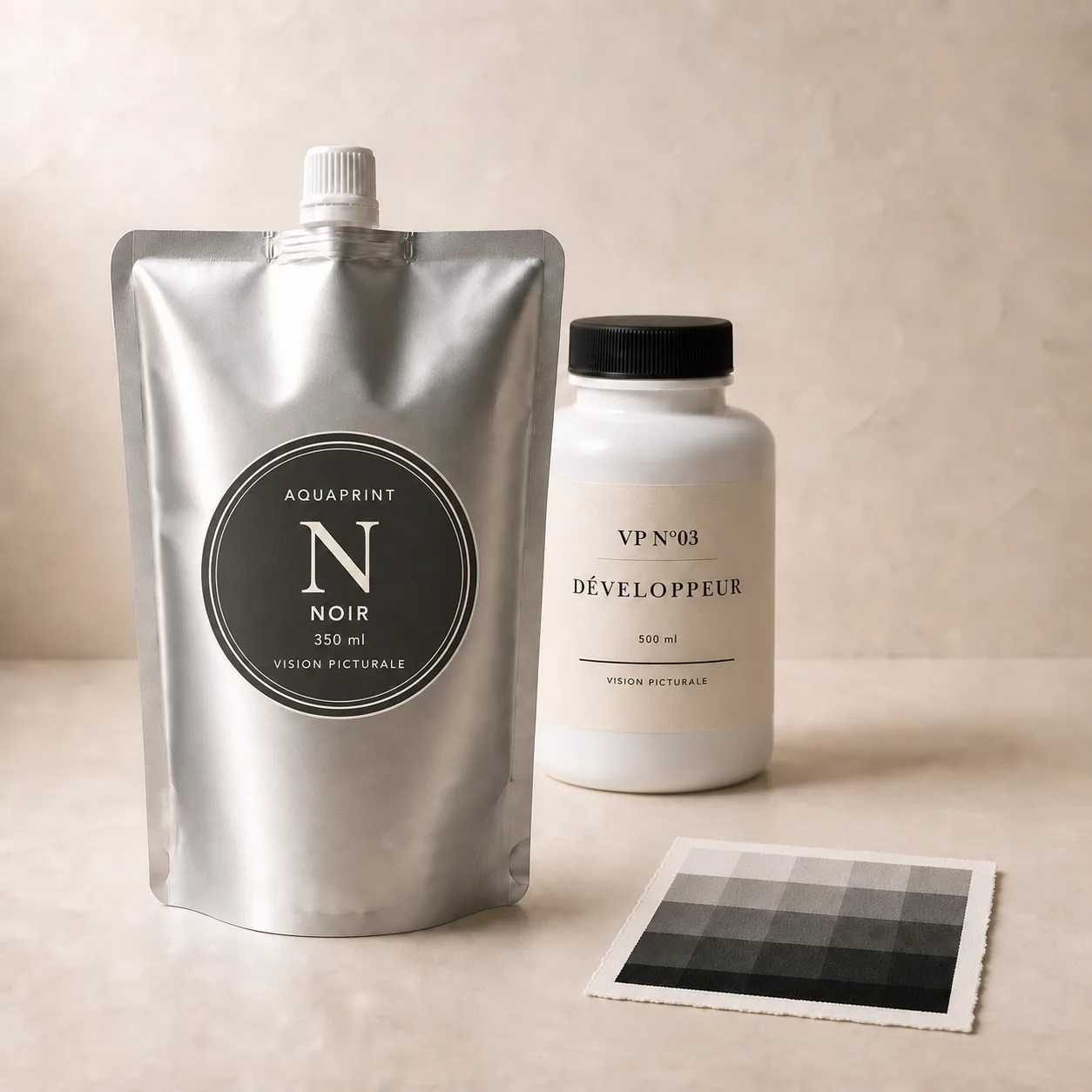
Gum Print Monochrome is the black variant of Aquaprint. A ready-to-use black pouch — gum, pigment and sensitiser already mixed — produces a monochrome of unique depth: less dense than carbon, but with incomparable watercolour softness. Ideal for portraits and still life.
The pictorialist softness
Monochrome gum bichromate allowed early 20th-century pictorialists to produce photographic images resembling charcoal drawings. In this spirit, VP Gum Print Monochrome uses a ready-to-use black pouch for a soft, velvety result. Without potassium bichromate — the pouch arrives already sensitised.
Materials
640 gsm watercolour paper · Transparent gesso · Black pouch — N (350 ml, ready to use) · VP N°03 Developer · Wide brush · Foam roller
Working guidance
Read the safety information for each product, prepare your workspace and use the indicated protection before handling it.
The supports
What we print on
Every process is contact-printed on an absorbent support. PULPØ 900 gsm is the studio’s own — smooth, heavy, ready to use. Standard watercolour papers also work, once primed.
See the supports in the shop- PULPØ — 900 gsm · 25 × 35 cm (10 sheets)
- Ready to use, no primer needed. Smooth 900 gsm support in its actual 25 × 35 cm format.
- Watercolour Paper 300 gsm — A4
- The everyday weight. Universal Primer is required.
- Watercolour Paper 640 gsm — A4
- The heavy weight, no cockling. Universal Primer is required.
- VP N°04 — Universal Primer
- Required with 300 and 640 gsm watercolour papers. Mark “I already have it” if you own some.
Makes watercolour papers usable
In 4 steps
How it works
Prepare
Scald the 640 gsm sheet, then apply 4 coats of transparent gesso (sizing).
Calibrate
Pour the Black pouch into a bowl — gum, pigment and sensitiser are already mixed — then apply by brush and roll with a foam roller.
Expose
Expose with the Luminograph (2 to 4 min — negative).
Reveal
Develop 10 s in diluted VP N°03 developer bath, then clear in hot water (40°C) — a soft, deep black watercolour appears.
Frequently asked questions
Everything about this process
What is Gum Print Monochrome?
Gum Print Monochrome is the carbon black variant of Aquaprint, Vision Picturale's dichromate-free reformulation of gum bichromate. A ready-to-use black pouch — gum, pigment and sensitiser already mixed — produces, in a single layer, a monochrome of velvety depth: less dense than carbon transfer, but with a watercolor softness that industrial silver gelatin processes never managed to reproduce. This charcoal-like rendering is the visual signature of early twentieth-century Pictorialism: Robert Demachy's monochrome gums Contrasts and Severity (1904), or Constant Puyo's La Tapisserie (circa 1900), are its historical references. The print leaves the texture of 640 gsm cotton paper visible through the pigment, with soft transitions ideal for portraits and still lifes. Clearing in warm water at 40°C reveals the image without any toxic chemical and without a darkroom.
What are the steps of a Gum Print Monochrome?
A Gum Print Monochrome follows the Aquaprint protocol reduced to a single layer, making it the fastest route to a finished print in the Vision Picturale gum family. The practitioner first scalds the 640 gsm 100% cotton watercolor sheet, then applies four coats of transparent gesso as sizing. The Black pouch emulsion — gum, pigment and sensitiser already mixed — is poured, applied with a wide brush to preserve the gestural mark, then evened out with a foam roller. After thirty minutes of dark drying, exposure under a 395-400 nm UV-A Luminograph lasts two to four minutes depending on negative density. Development immerses the print for ten seconds in diluted VP N°03 developer, followed by clearing in warm water at 40°C. Where four-color CMYK requires eight to ten hours over two days, a single layer suffices here.
How does Gum Print Monochrome differ from carbon transfer?
Gum Print Monochrome and the Vision Picturale carbon transfer process both produce dichromate-free black pigment prints, but aim at distinct aesthetics. Carbon transfer offers the highest dMax of all alternative processes, above 2.1, with a slight bas-relief visible in raking light; it requires transferring a pigmented gelatin and around four to five hours for the Carbon Mono — Museum Black variant. Gum Print Monochrome is less dense but of incomparable watercolor softness: the black pigment stays in the gum applied directly by brush, without transfer or registration alignment, in a single layer. The cotton paper texture remains visible through the pigment, with soft transitions inherited from Pictorialism. The practitioner will choose carbon transfer for museum-grade archives and maximum tonal depth, and Gum Print Monochrome for portraits and still lifes with watercolor texture.
Is Gum Print Monochrome a good first gum process?
Gum Print Monochrome is the recommended entry point into the Vision Picturale gum family, accessible from advanced-beginner level after five to ten successful cyanotype prints. It requires only one separation negative, tolerates exposure deviations of thirty seconds, and accepts approximate registration between layers, where four-color CMYK demands millimetric registration across four negatives and exposure control to within ten seconds. The VP catalog rates the Coffret Aquaprint Mono — Aquarelle Photo at beginner-plus level. Beyond the kit, the practitioner needs 640 gsm 100% cotton watercolor paper, transparent gesso for sizing, a wide brush, a foam roller, and nitrile gloves. A wide brush preserves the gestural mark that distinguishes hand-coated gum prints. Fifteen to twenty monochrome prints remain the concrete preparation Vision Picturale recommends before tackling four-color CMYK Aquaprint and its registration constraints.
How permanent is a Gum Print Monochrome print?
A Gum Print Monochrome kept in standard conditions resists for several centuries, a permanence comparable to the historic gum bichromates still visible at the Musée d'Orsay and the Metropolitan Museum of Art in New York. Robert Demachy's monochrome gums dated 1904, Contrasts and Severity, attest to this stability after more than a century. The carbon black pigment is chemically inert, UV-resistant, and rated ASTM I maximum lightfastness, embedded in gum arabic that becomes insoluble once hardened by UV exposure. No silver salt and no light-sensitive organic dye enters the formulation. The practitioner must mount the print on neutral pH 7 to 8.5 board, frame it behind anti-reflective glass, and keep humidity below 60% at stable temperature. A correctly mounted Gum Print Monochrome keeps its initial density without any restoration work.
Chemistry kit
Gum Print Monochrome
Gum Print Monochrome is the black variant of Aquaprint. A ready-to-use black pouch — gum, pigment and sensitiser already mixed — produces a monochrome of unique depth: less dense than carbon, but with incomparable watercolour softness. Ideal for portraits and still life.
An alternative
Rather have it printed for you?
The artisan printmakers of Maison Picturale, a Paris atelier and gallery, produce prints in this process on commission, by hand, on 100% cotton paper. Vision Picturale supplies the kits; Maison Picturale handles the finished artwork.
Order a print at Maison PicturaleMaison Picturale · Paris 20e