Alternative process
IntermediateCarbon Process
Deep blacks and a visible relief
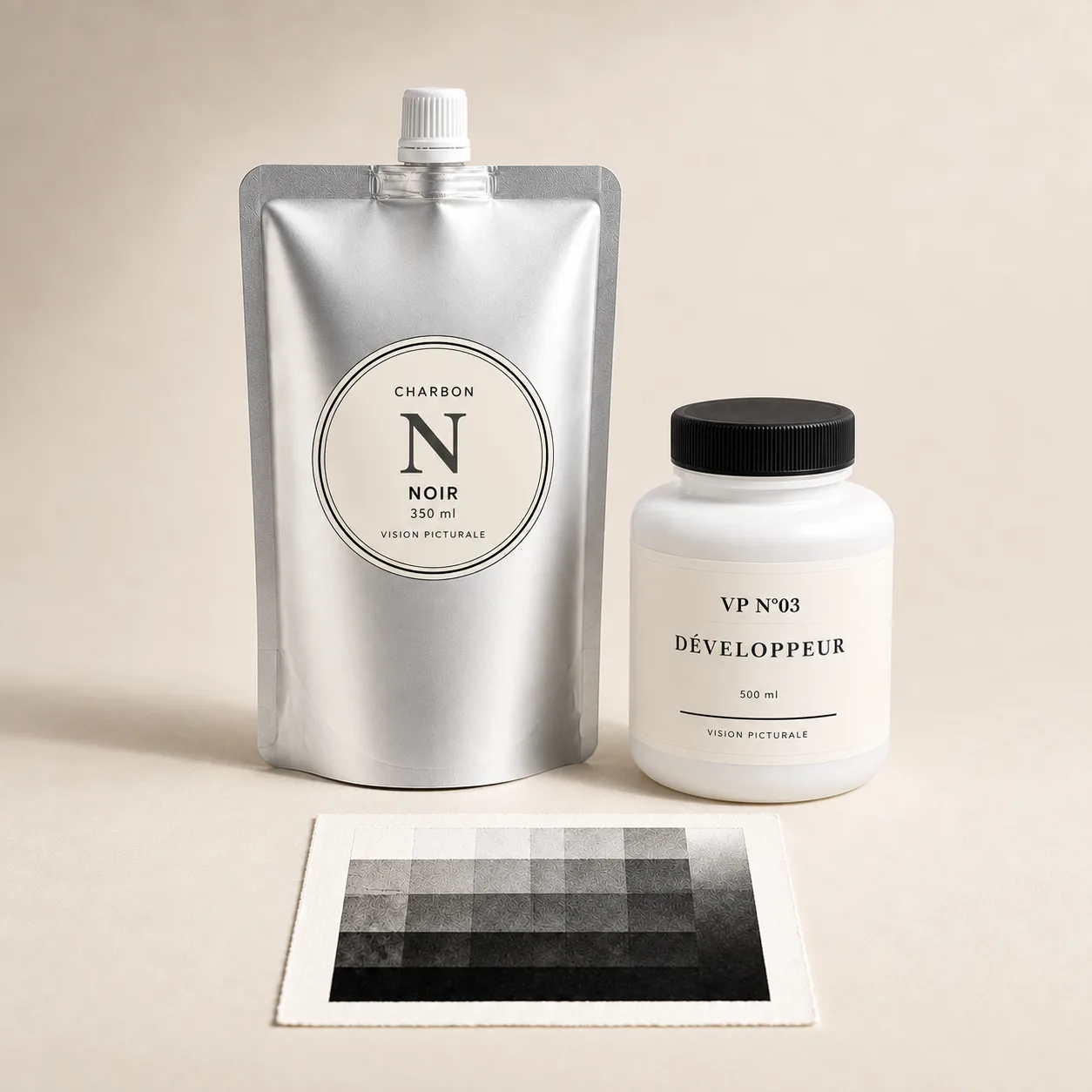
The Carbon process — carbon transfer — uses pigmented gelatin whose thickness varies with exposure. The result: blacks of maximum density and a slight bas-relief visible in raking light. One kit is still being developed, the Carbon Mono — Museum Black: it can be looked at, it cannot be bought yet. Aquaprint, the perfect compromise between gum bichromate and carbon printing, gives you its essence today — the painterly matter of gum, the depth of carbon, without dichromate.
An alternative
Aquaprint, the perfect compromise
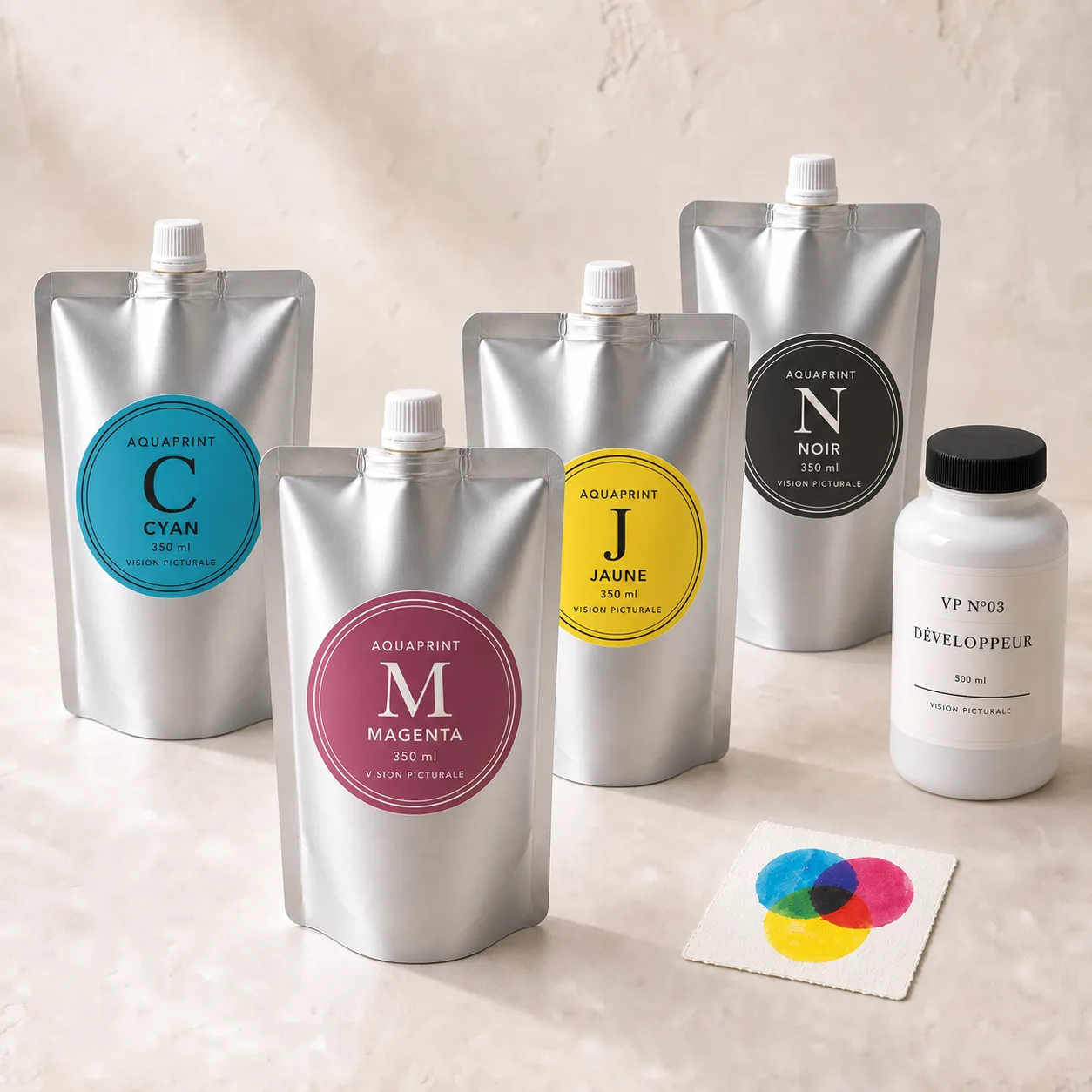
Aquaprint, the perfect compromise between gum bichromate and carbon printing — the painterly matter of gum, the depth of carbon, without dichromate. Aquaprint pouches are ready to use — gum, pigment and sensitiser already mixed — in Mono, Sanguine, CMYK and Gamut. It is Vision Picturale's flagship process, and the only one of the two you can order today.
The Holy Grail of printing
Carbon printing offers the highest density (dMax) of all alternative processes. The thickness of pigmented gelatin creates a slight relief visible in raking light, giving the image a unique physical presence. It is the process with the best archival permanence — centuries of conservation. It is also the most demanding: tissue preparation, transfer, layer registration. This is what led Vision Picturale to focus its offer on Aquaprint, and to keep only one Carbon kit, the Mono, still being developed.
Materials
Transfer paper · Pigmented gelatin · Final 640 gsm cotton support · UV light
Working guidance
Read the safety information for each product, prepare your workspace and use the indicated protection before handling it.
The supports
What we print on
Every process is contact-printed on an absorbent support. Standard watercolour papers work very well, once coated with the Universal Primer.
See the supports in the shop- Watercolour Paper 300 gsm — A4
- The everyday weight. Universal Primer is required.
- Watercolour Paper 640 gsm — A4
- The heavy weight, no cockling. Universal Primer is required.
- VP N°04 — Universal Primer
- Required with 300 and 640 gsm watercolour papers. Mark “I already have it” if you own some.
Makes watercolour papers usable
In 4 steps
Make a Carbon print in 4 steps
Prepare
Prepare the carbon tissue (pigmented gelatin) and sensitise it.
Calibrate
Print your negative on transparent film with the carbon ICC profiles.
Expose
Expose the tissue in contact with the negative under the Luminograph (5-12 min).
Reveal
Transfer onto the final support and develop in warm water. Unexposed gelatin dissolves.
Maximum density
Why Carbon has the highest dMax of all alternative processes
dMax — maximum density — measures the deepest black a process can reach. An Epson inkjet reaches 1.8 to 2.0. A museum-grade baryta silver print tops out at 2.2. A cyanotype: 1.4. A single-layer Aquaprint: 1.3. Carbon exceeds 2.4 — the only non-silver process to do so.
The explanation is physical, not chemical. Where every other process deposits a thin layer of matter (a few microns), Carbon deposits a layer of pigmented gelatin of variable thickness: the more a zone was exposed, the thicker it is. In pure shadows, 50 to 80 microns of solid pigment. Matter stacked, not spread.
This thickness produces two effects unique to Carbon. First, a slight bas-relief visible in raking light — the image is physically palpable, you can feel it with a fingertip. Second, a perceptual saturation of black unlike any other: you don't see a dark tone, you see an absence of light.
This is why Carbon was the reference process of museums and private collections from 1864 to 1930, and why it remains the most prized by collectors of photographic prints. Its archival permanence — several centuries documented on late-19th-century Carbro prints — comes from the inert pigment and the gelatin hardened right through. Multi-layer Aquaprint comes close in depth, with the suppleness of gum on top.
Frequently asked questions
Everything about this process
Does Vision Picturale sell a Carbon kit?
Not yet. One Carbon kit remains in the catalogue since 8 September 2026, the Carbon Mono — Museum Black, and it is still being developed: it is shown, it is not sold, and its composition is not settled. The three other Carbon kits were withdrawn the same day, before any sale: tissue preparation, transfer and layer registration made it the most demanding process in the catalogue. The offer focuses on Aquaprint, the house's flagship process. Aquaprint, the perfect compromise between gum bichromate and carbon printing — the painterly matter of gum, the depth of carbon, without dichromate. Ready-to-use Aquaprint pouches come in Mono, Sanguine, CMYK and Gamut. The printers of Maison Picturale make carbon prints on request.
What is the origin of carbon transfer?
The carbon transfer process is a pigment photographic process invented in 1864 by Englishman Joseph Wilson Swan, patented the same year and presented to the Royal Photographic Society in London. The historic process relies on a pigmented gelatin sensitized with potassium dichromate, exposed under a negative, then transferred to a final support after clearing in warm water. The Vision Picturale carbon transfer process preserves pigment chemistry and transfer logic, but completely removes potassium dichromate through alternative sensitization with Universal Sensitizer on pigmented gelatins ready to expose. It comes in carbon black for the Carbon Mono — Museum Black variant three earths for the Carbon Sanguine variant, and cyan, magenta, yellow, black for the Carbon CMYK — Deep Colour variant in four successive transfers. The Carbon Gamut variant carries seven pigments, hence seven transfers. The rendering presents a slight bas-relief visible in raking light, exclusive signature of carbon transfer.
What are the steps of CMYK carbon transfer?
A Carbon CMYK — Deep Colour Vision Picturale carbon transfer print in four CMYK transfers requires roughly sixteen to twenty hours spread over four days. Each transfer follows an identical cycle: exposure of pigmented gelatin sensitized with the sensitizer under a 395-400 nm Luminograph A3+ unit for three to six minutes depending on the separation negative, transfer onto final support by wet contact for ten minutes, development in warm water at 40°C for fifteen to twenty minutes until complete clearing, four to six hours of drying before the next color transfer. Registration between layers uses half-millimeter marks. The monochrome Carbon Mono — Museum Black variant requires a single sequence, around four to five hours. The practitioner can concretely plan a color print over a full weekend by parallelizing drying and preparation steps.
How does carbon transfer differ from resinotype?
The Vision Picturale carbon transfer process offers the highest dMax of all alternative processes, above 2.1 by densitometric measurement, against roughly 1.7 for VP resinotype. This tonal depth stems from the thickness of the transferred pigmented gelatin, several tens of microns against just a few microns for resinotype. Carbon transfer also produces a slight bas-relief visible in raking light, a signature absent from resinotype whose finish is plane and vitrified by its polymerized VP resin. The practitioner will choose carbon transfer for subjects with wide tonal range where deep black saturates the image. Resinotype suits mineral subjects better, where velvety finish and varnished microreliefs prevail. Both processes share gelatin and Sensitizer, and both exclude dichromate.
What skill level does carbon transfer require?
The Vision Picturale carbon transfer process sits between intermediate and advanced level depending on the variant. The monochrome Carbon Mono — Museum Black variant remains accessible to the intermediate practitioner who has completed thirty to forty cyanotype and Aquaprint prints, since it requires only a single transfer without registration alignment. The Carbon CMYK — Deep Colour variant in four CMYK transfers demands a confirmed level: precise registration to within half a millimeter between four separation negatives, transfer temperature control at constant 40°C, and mastery of differential clearing. In addition to the kit (pigmented gelatins + Sensitizer), the practitioner must acquire a thermostatic tray or cooking thermometer, final supports in baryta or watercolor paper, and a rigid contact press frame for Luminograph A3+ exposure.
How permanent is a carbon transfer print?
A carbon transfer print lasts several centuries and constitutes the most permanent photographic process ever documented, as attested by late 19th century carbon prints preserved at the Musée d'Orsay and at George Eastman House in Rochester, still without visible alteration more than one hundred and fifty years after their printing. This stability stems from the pigments used (carbon black, mineral oxides, ASTM I), incorporated into gelatin hardened by Universal Sensitizer. The carbon transfer process contains neither silver salt nor sensitive organic dye. The practitioner must nonetheless mount carbon prints on neutral pH 7 to 8.5 board in an environment with stable humidity below 60%. Vision Picturale carbon transfer, without dichromate, preserves this original multi-century permanence while eliminating the health risk.
Chemistry kit
Carbon Process
The Carbon process — carbon transfer — uses pigmented gelatin whose thickness varies with exposure. The result: blacks of maximum density and a slight bas-relief visible in raking light. One kit is still being developed, the Carbon Mono — Museum Black: it can be looked at, it cannot be bought yet. Aquaprint, the perfect compromise between gum bichromate and carbon printing, gives you its essence today — the painterly matter of gum, the depth of carbon, without dichromate.
An alternative
Want a Carbon print without making it yourself?
Carbon demands the most exacting practice of all alternative processes: tissue preparation, transfer, colour layer registration. The Vision Picturale Carbon Mono kit is not on sale yet. The printers of Maison Picturale produce Aquaprint prints and, on request, carbon prints — formats up to Jésus, documented archival permanence.
Commission a printMaison Picturale · Paris 20e