Alternative process
AdvancedAquaprint
The precision of photography, the luminosity of watercolour
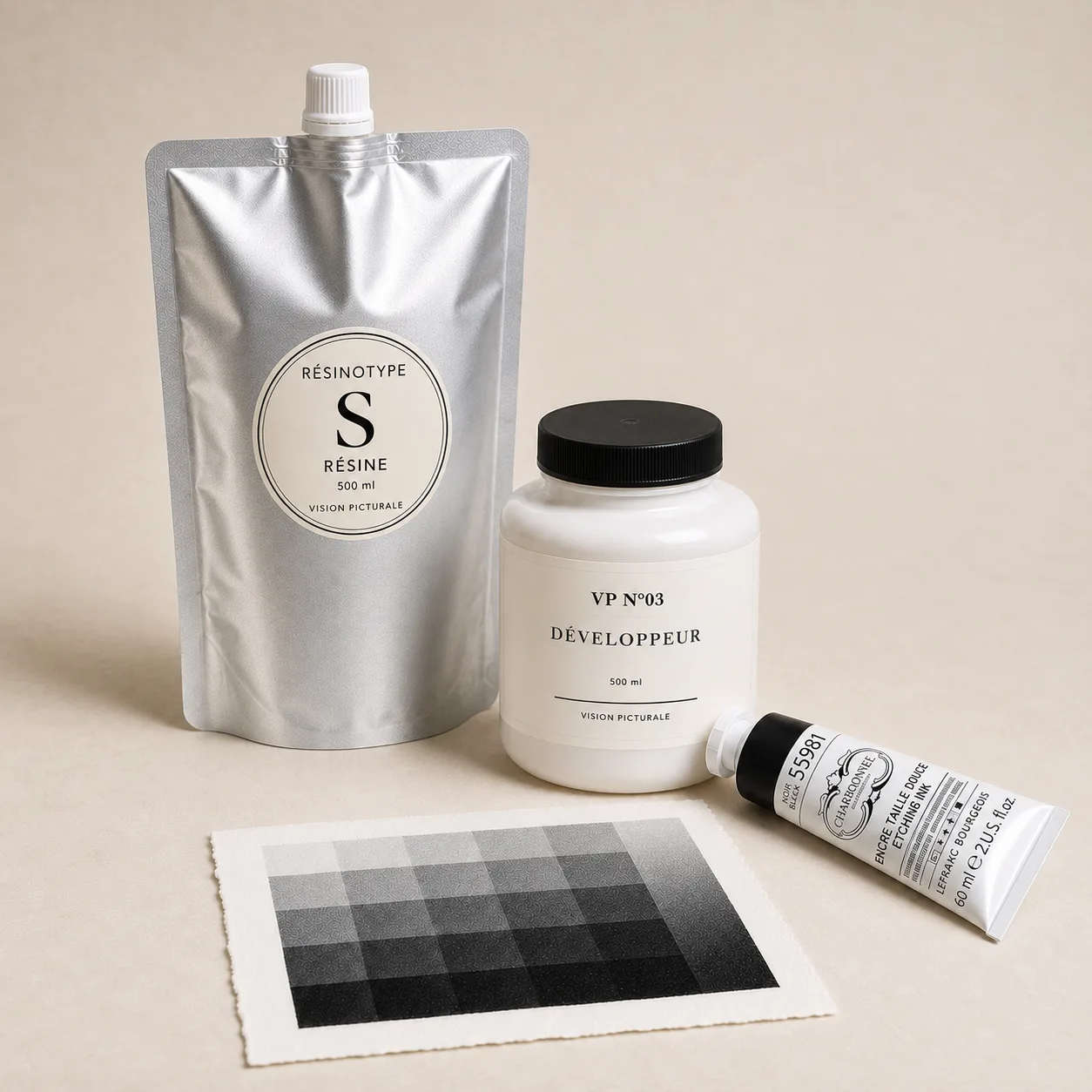
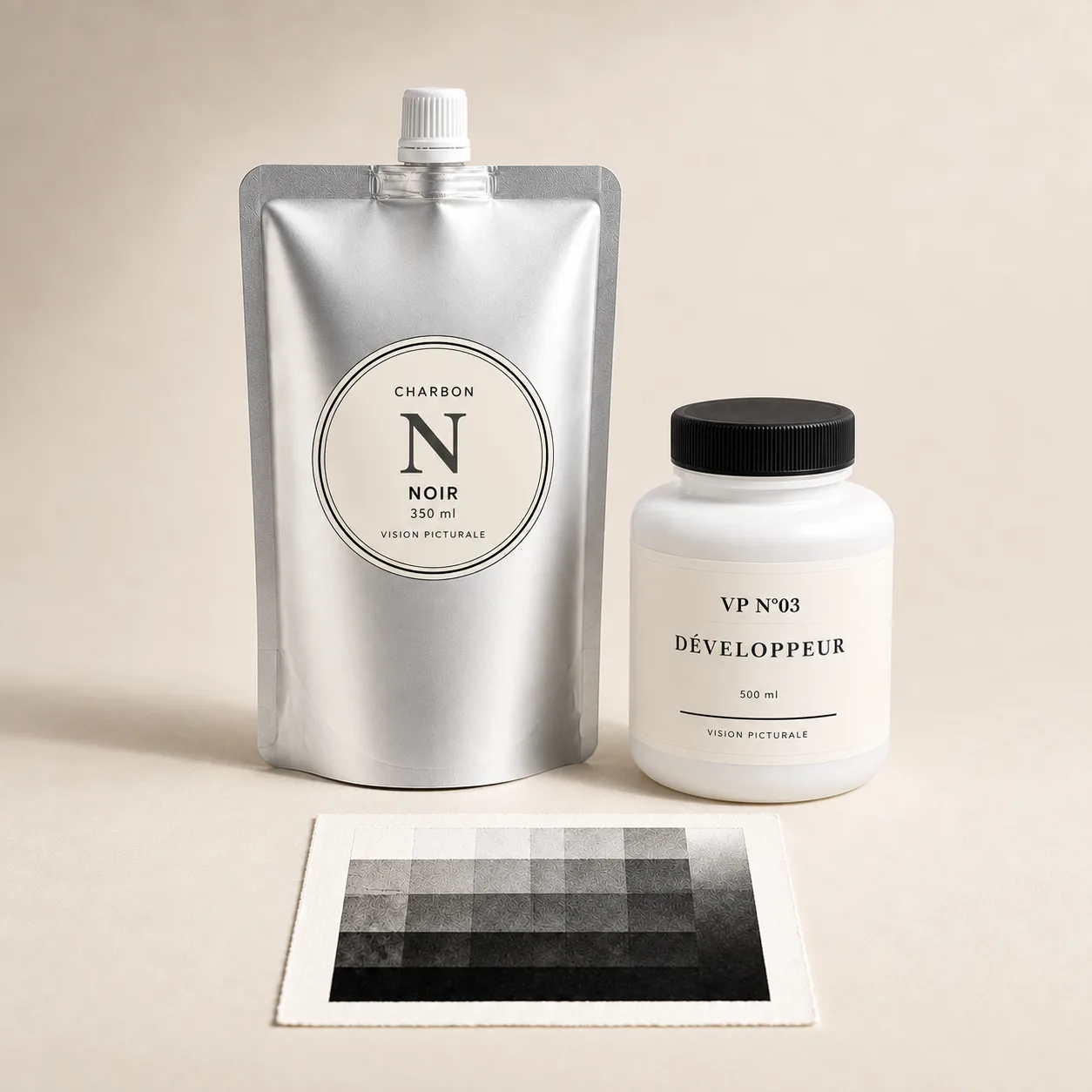
Aquaprint — our name for gum print — uses ready-to-use pouches in which gum, pigment and sensitiser are already mixed. After sizing with transparent gesso, application by brush and foam roller, Luminograph exposure, the VP N°03 developer followed by hot water clearing reveals your image.
The pictorialist heritage
This process allows the artist to physically intervene on the image during development. The pigments create images that are as much drawings as photographs. Early 20th-century pictorialists made it their technique of choice. The VP kit eliminates all the complex chemistry of the old process: each pouch already contains the gum, the pigment and the sensitiser. Aquaprint, the perfect compromise between gum bichromate and carbon printing — the painterly matter of gum, the depth of carbon, without dichromate.
Materials
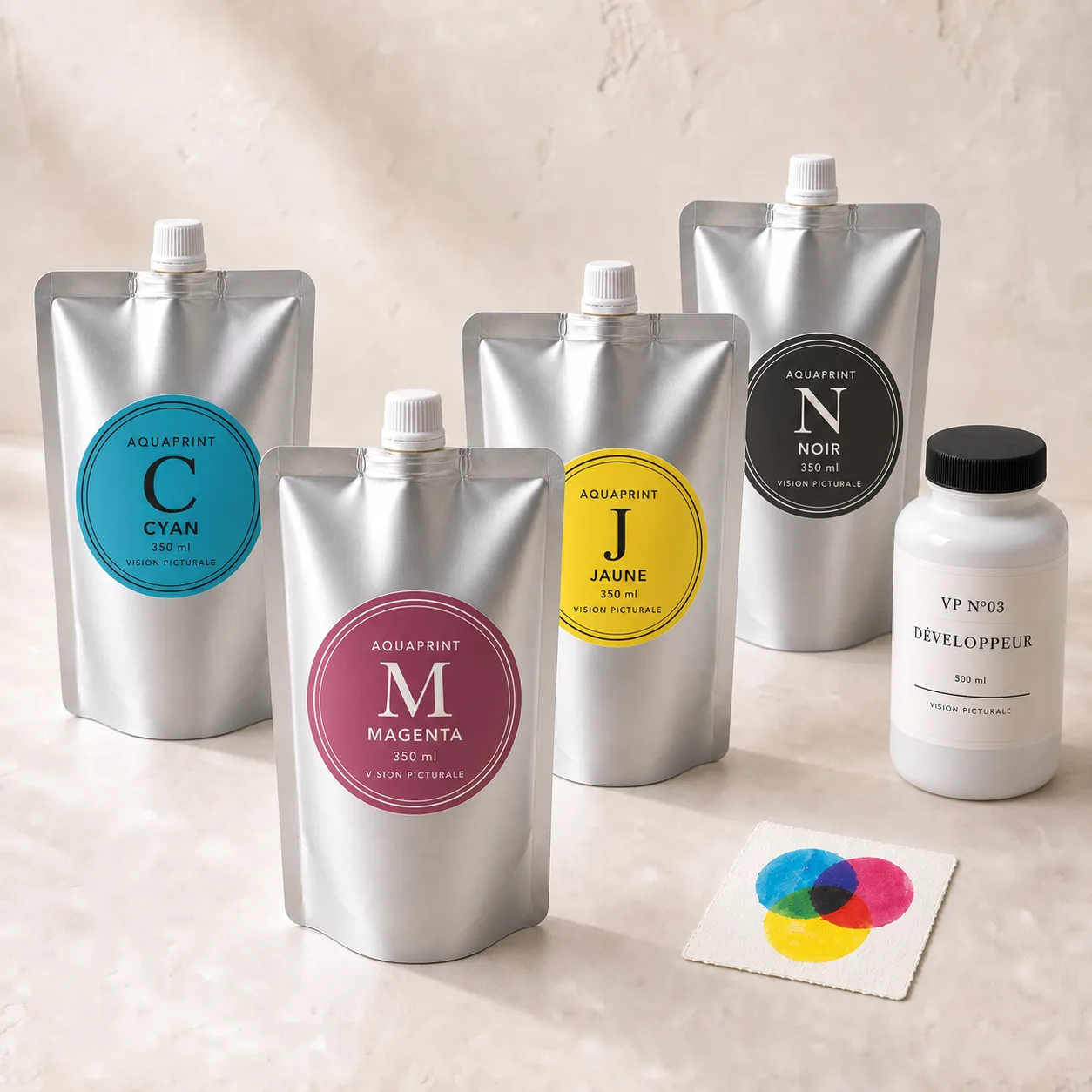
640 gsm watercolour paper · Transparent gesso · Cyan, Magenta, Yellow and Black pouches (350 ml, ready to use) · VP N°03 Developer · Wide brush · Foam roller
Four variants
- Aquaprint CMYK — WatercolourFour-colour pigment process, layer after layerIn production
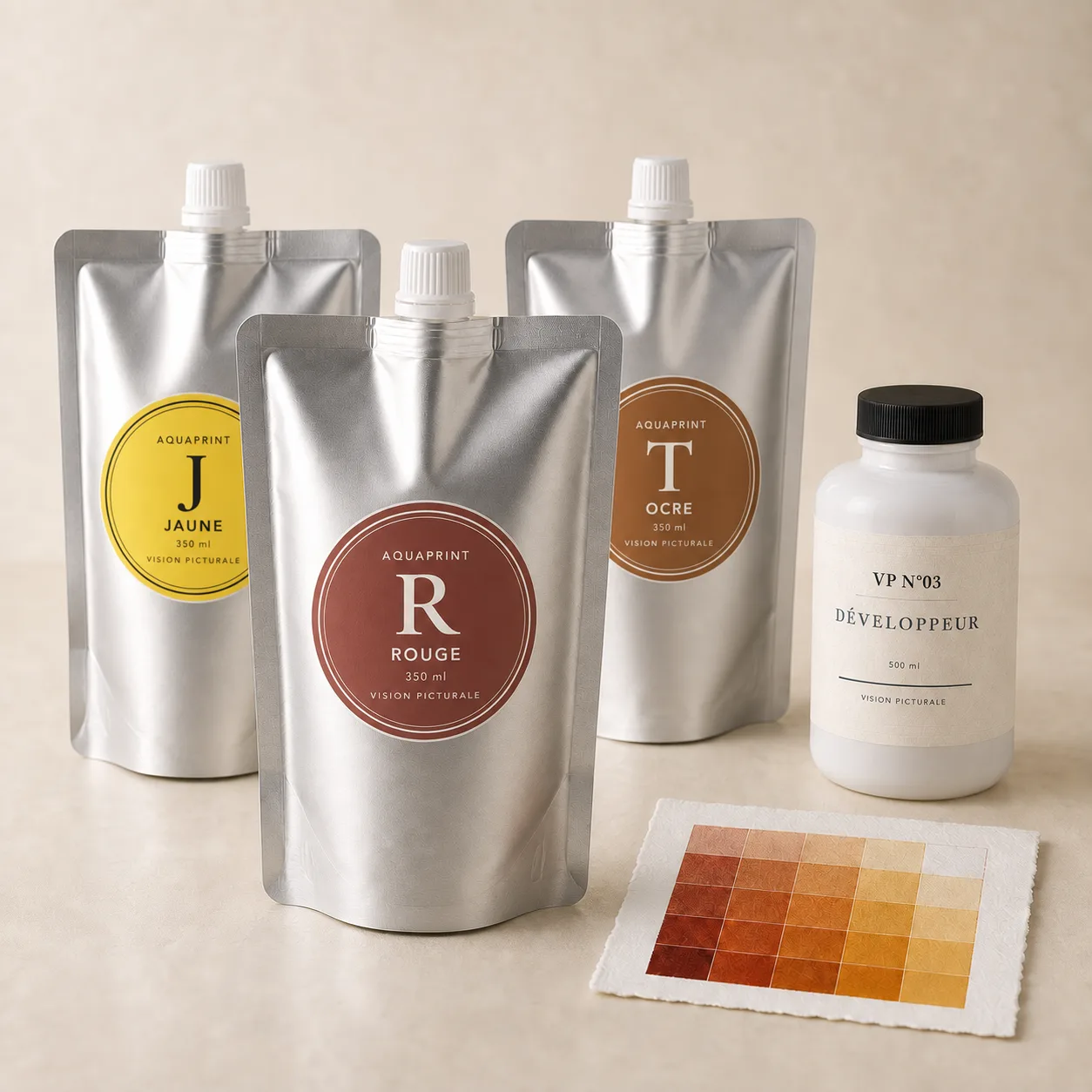
- Aquaprint SanguineThe soul of a Renaissance drawing, three earthsIn production
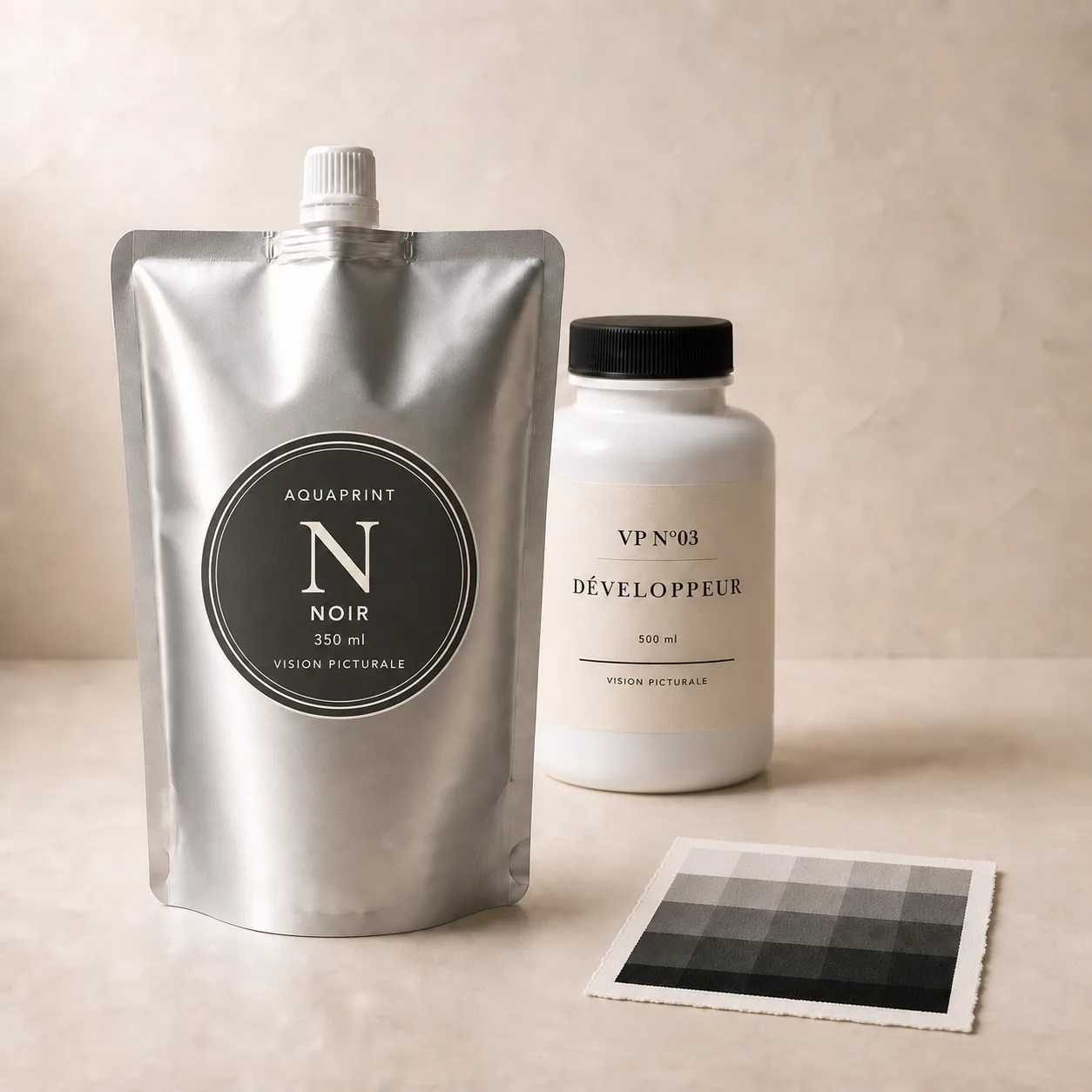
- Aquaprint Mono — Photo WatercolourDeep black, gentle touchIn production
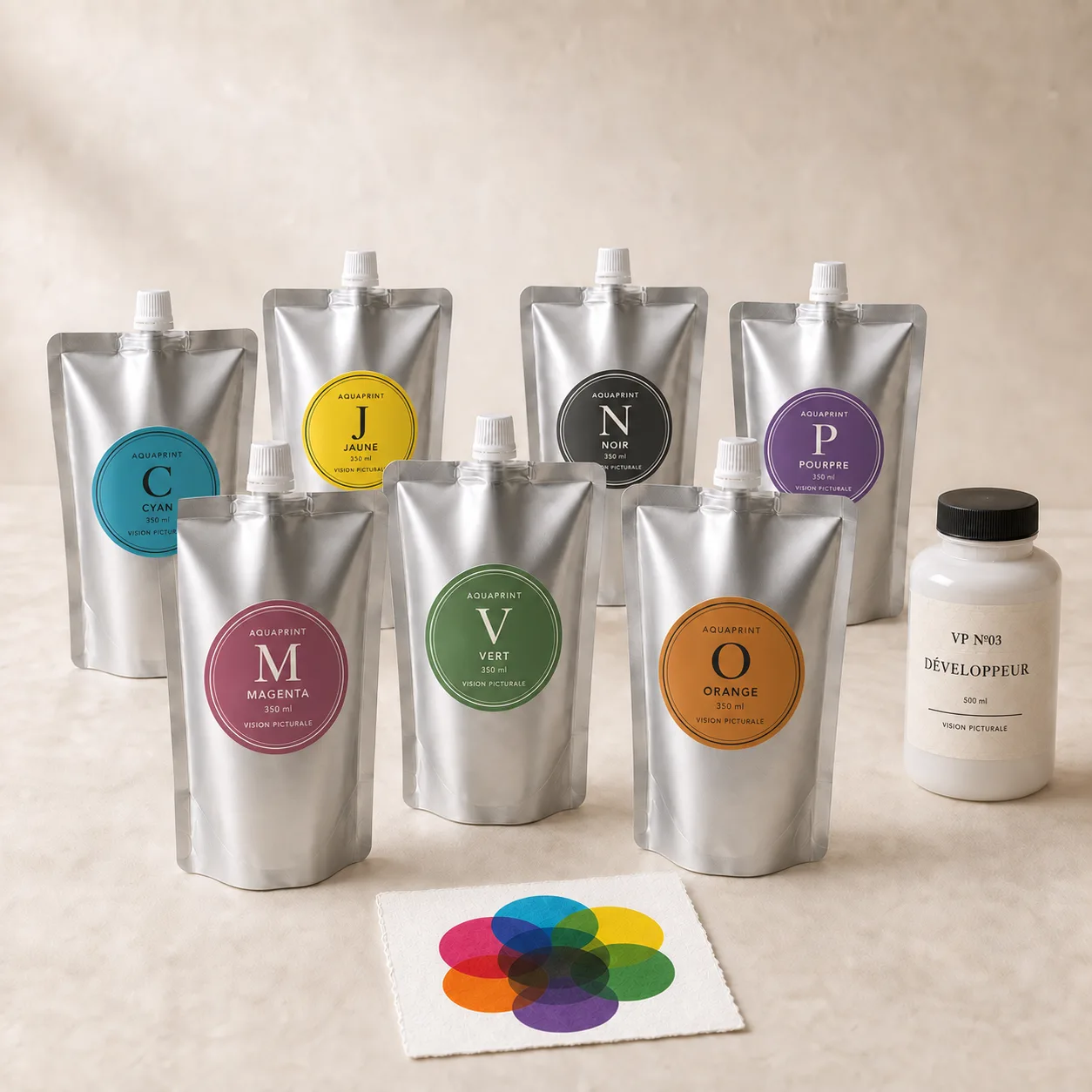
- Aquaprint GamutSeven pigments, the gamut extended beyond CMYKIn production
Working guidance
Read the safety information for each product, prepare your workspace and use the indicated protection before handling it.
The supports
What we print on
Every process is contact-printed on an absorbent support. PULPØ 900 gsm is the studio’s own — smooth, heavy, ready to use. Standard watercolour papers also work, once primed.
See the supports in the shop- PULPØ — 900 gsm · 25 × 35 cm (10 sheets)
- Ready to use, no primer needed. Smooth 900 gsm support in its actual 25 × 35 cm format.
- Watercolour Paper 300 gsm — A4
- The everyday weight. Universal Primer is required.
- Watercolour Paper 640 gsm — A4
- The heavy weight, no cockling. Universal Primer is required.
- VP N°04 — Universal Primer
- Required with 300 and 640 gsm watercolour papers. Mark “I already have it” if you own some.
Makes watercolour papers usable
In 4 steps
Make an Aquaprint in 4 steps
Prepare
Scald the 640 gsm sheet, then apply 4 coats of transparent gesso (sizing).
Calibrate
Pour the pouch into a bowl — gum, pigment and sensitiser are already mixed — then apply by brush and roll with a foam roller.
Expose
Expose with the Luminograph (2 to 5 min depending on pigment — negative).
Reveal
Develop 10 s in diluted VP N°03 developer bath, then clear in hot water (40°C) — the image appears before your eyes.
Historic bridge
Aquaprint vs historic gum bichromate: what we changed
Gum bichromate — also called gum print or gumprint — has been the pictorialist process par excellence since 1894. But its original formula relies on potassium or ammonium bichromate: a chromium VI salt classified as a proven carcinogen (CMR 1A), banned for non-professional use in France since 2018. Impossible to practice in a kitchen.
Aquaprint preserves the entire visual grammar of gum bichromate: brush application, layered passes, physical intervention with a roller, hot water clearing that reveals the image. The gesture is identical. The rendering — translucent pigment layers on cotton paper — is indistinguishable from the original to the naked eye.
What we changed: the sensitisation chemistry. VP gum is pre-sensitised with a dichromate-free system. The VP N°03 developer replaces the bichromic acid baths of the historic process. Read the product-specific safety information before use.
The process remains approachable for learning, with appropriate equipment and the indicated precautions. The change concerns the sensitisation chemistry while preserving the pictorialist gesture.
Frequently asked questions
Everything about this process
What are the steps of CMYK Aquaprint?
A four-color Aquaprint Vision Picturale print comprises four successive CMYK layers. The practitioner pours the pouch for the relevant layer — gum, pigment and sensitiser already mixed — and applies it with a flat brush onto 640 gsm 100% cotton watercolor paper, and lets it dry thirty minutes in darkness. Exposure under a 395-400 nm Luminograph A4 unit lasts two to five minutes depending on separation negative density. Development immerses the print in diluted VP N°03 developer, followed by clearing in warm water at 40°C for five to ten minutes: unexposed gum dissolves, hardened pigment remains. After two hours of drying, the next layer is applied. A complete four-layer A4 print requires roughly eight to ten hours spread over two days.
How does Aquaprint differ from Gumoil?
Aquaprint Vision Picturale differs from Gumoil through its use of pigments dispersed in the pre-sensitised gum of the pouch, revealed by clearing in warm water at 40°C which dissolves unexposed gum. Gumoil uses the same gum and the same sensitizer, but incorporates ground oil pigments fixed by selective adhesion without aqueous clearing. Aquaprint enables CMYK four-color printing, therefore color images faithful to the negative, which Gumoil does not allow in practice. The practitioner will choose Aquaprint for complex color images or nuanced graphic monochromes, and reserve Gumoil for contrasted graphic subjects where the raw pigment matter prevails over tonal fidelity.
How permanent is an Aquaprint print?
An Aquaprint Vision Picturale print kept in standard conditions resists for several centuries, a permanence comparable to the historic Demachy gum bichromates still visible at the Musée d'Orsay and the Metropolitan Museum of Art in New York. This longevity stems from the mineral pigments used, earths and metallic oxides rated ASTM I lightfast in Winsor & Newton or Sennelier catalogues, and from the inertia of gum arabic once hardened by Universal Sensitizer. The practitioner must nonetheless choose only pigments with maximum light stability rating, avoiding organic lakes and certain aniline reds. The final print supports standard framing behind anti-reflective glass, in an environment with humidity below 60%.
Chemistry kit
Aquaprint
Aquaprint — our name for gum print — uses ready-to-use pouches in which gum, pigment and sensitiser are already mixed. After sizing with transparent gesso, application by brush and foam roller, Luminograph exposure, the VP N°03 developer followed by hot water clearing reveals your image.
An alternative
Want an Aquaprint artwork, not make it yourself?
The artisans of Maison Picturale produce Aquaprint prints on commission — colour (CMYK), sanguine or monochrome — in their Paris atelier. Minimum three passes, 640 gsm cotton paper. Vision Picturale supplies the kit to practice at home; Maison Picturale supplies the finished, signed artwork.
Order an AquaprintMaison Picturale · Paris 20e