Mineral velvet
Resinotype is a pigment process: gelatin is modified by UV light, then receives pigment powder via foam roller. Hardened areas retain the pigment, creating an image with a silky texture and blacks of exceptional depth.
Materials
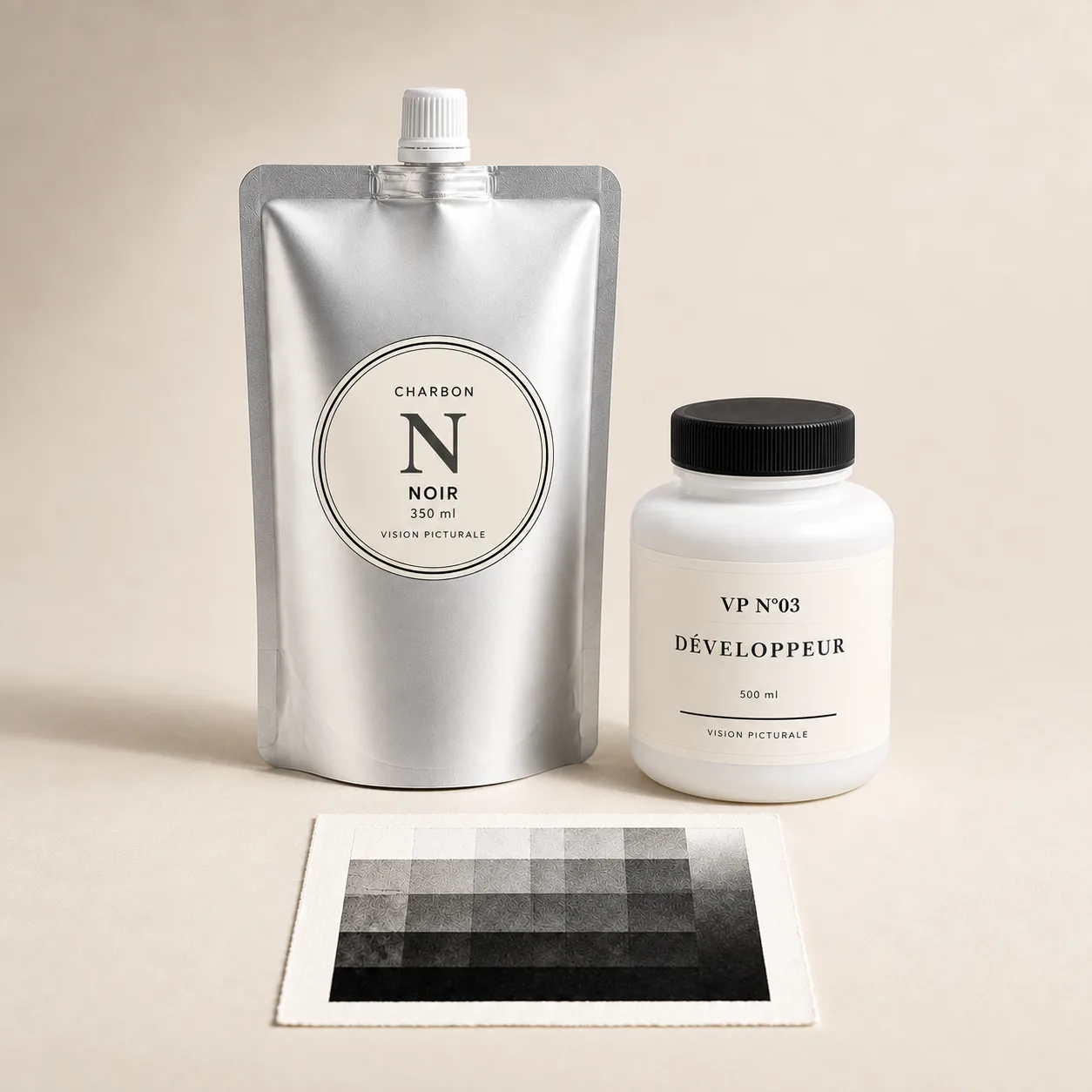
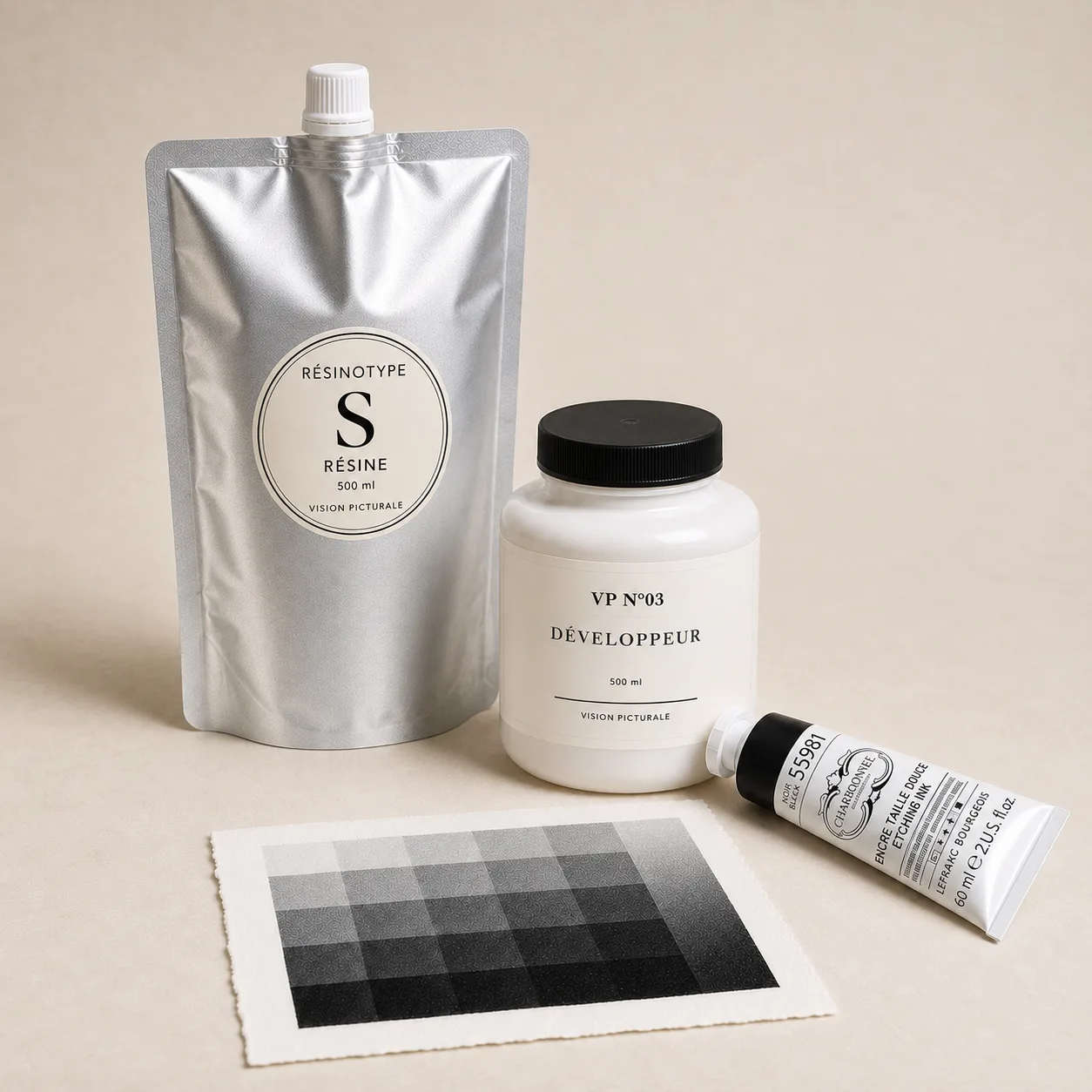
640 gsm watercolour paper · Resin pouch — S (350 ml, pre-sensitised gelatine, poured on) · VP N°03 Developer · Black pigment VP N°07 cool or VP N°11 warm · Foam roller
Working guidance
Read the safety information for each product, prepare your workspace and use the indicated protection before handling it.
The supports
What we print on
Every process is contact-printed on an absorbent support. PULPØ 900 gsm is the studio’s own — smooth, heavy, ready to use. Standard watercolour papers also work, once primed.
See the supports in the shop- PULPØ — 900 gsm · 25 × 35 cm (10 sheets)
- Ready to use, no primer needed. Smooth 900 gsm support in its actual 25 × 35 cm format.
- Watercolour Paper 300 gsm — A4
- The everyday weight. Universal Primer is required.
- Watercolour Paper 640 gsm — A4
- The heavy weight, no cockling. Universal Primer is required.
- VP N°04 — Universal Primer
- Required with 300 and 640 gsm watercolour papers. Mark “I already have it” if you own some.
Makes watercolour papers usable
In 4 steps
Reveal a Resinotype in 4 steps
Prepare
Pour the gelatine from the Resin pouch onto the sheet, laid on a levelled glass plate, then let it dry.
Calibrate
Print your positive on transparent film.
Expose
Expose with the Luminograph, develop in the VP N°03 developer bath.
Reveal
Reveal the image with the foam roller using black pigment.
Roller reveal
The foam roller reveal: the mechanics of powder pigment
Resinotype is the only alternative process where the image doesn't exist after exposure — it only exists after the roller reveal. Until you've passed the foam roller loaded with black pigment, the sheet remains apparently blank. That's what makes it so strange to practice the first time.
Mechanically: the VP gelatin, selectively hardened by UV through the negative, presents differential micro-roughness. The most hardened areas (image shadows) grab the powder pigment by physical adhesion; the unhardened, smooth areas repel it. You pass the dry roller over the moist sheet, and the image appears stroke by stroke.
The visual result is unique: a deep, matte mineral velvet that evokes charcoal or graphite powdered on textured paper. No other photographic process produces this texture. Carbon has the deepest black, but glossy; baryta silver has the precision, but smooth. Resinotype, matte and velvety, lives with the light of the room.
For a draughtsman or printmaker, it's the most immediately familiar process — the roller gesture replaces the charcoal stroke, but the source image is photographic. For a photographer, it's a doorway into drawing without abandoning the medium. Resinotype is probably the least documented alternative process in our catalogue, and the most surprising to discover.
Frequently asked questions
Everything about this process
What is the identity of resinotype?
Resinotype Vision Picturale is a pigment photographic process combining resinated gelatin and pigment to produce a natural varnished finish without external varnish application. VP resinotype relies on the gelatin of the Resin pouch, already resinated and sensitised, into which the chosen black pigment is incorporated — VP N°11 warm or VP N°07 cold — the resin hardening during final drying. Gelatin pouring is performed at a critical temperature of constant 40°C to guarantee a homogeneous layer. Resinotype is the only Vision Picturale process producing a velvety mineral vitrified finish with microreliefs visible in raking light. Unlike carbon transfer, there is no transfer. Unlike bromoil, there is no inking. Unlike Aquaprint, there is no clearing at 40°C.
What are the steps of a resinotype print?
A resinotype Vision Picturale print requires roughly six to eight hours spread over two days. The practitioner prepares the Resin pouch — gelatin already resinated and sensitised — supplemented with the chosen black pigment, maintained at constant 40°C in a thermostatic water bath. Pouring onto 640 gsm 100% cotton watercolor paper is done in a single regular pass, followed by three to four hours of flat drying. Exposure under a 395-400 nm Luminograph A3+ unit lasts three to six minutes depending on negative density. Development in lukewarm water at 30°C dissolves unexposed zones in ten to fifteen minutes. Final drying of twelve to twenty-four hours reveals the natural varnished finish through polymerization of VP resin. No external varnish is applied.
How does resinotype differ from carbon transfer?
Resinotype Vision Picturale and carbon transfer share gelatin sensitized by Sensitizer, without dichromate. Resinotype offers a velvety mineral finish vitrified by natural polymerization of VP proprietary resin, without external varnish application, giving an enameled object appearance with microreliefs in raking light. Carbon transfer produces a slight matte bas-relief characteristic of pigment transfer, with dMax above 2.1 against roughly 1.7 for resinotype. Resinotype requires neither transfer nor registration alignment. Carbon CMYK — Deep Colour carbon transfer allows four-colour CMYK printing in four transfers, which resinotype does not propose as standard. The practitioner will choose resinotype for mineral or architectural subjects where varnished finish prevails, and carbon transfer for maximum tonal depth.
What skill level does resinotype require?
Resinotype Vision Picturale sits between intermediate and advanced level, recommended after mastery of cyanotype and monochrome Aquaprint, so after twenty to thirty successful alternative prints. The difficulty lies in constant thermal control at 40°C during pouring of resinated gelatin sensitised with Universal Sensitizer: a deviation of more than two degrees causes thickness unevenness. Regularity of the brush pass also demands precise coordination. In addition to the kit (gelatin + Sensitizer + VP proprietary resin unnumbered), the practitioner must acquire a thermostatic water bath or a heating plate with digital thermometer, a magnetic stirrer for pigment homogenization, and a perfectly level horizontal drying support.
How permanent is a resinotype print?
A resinotype Vision Picturale print presents a permanence estimated at several centuries, comparable to reference gelatin-pigment pigment processes such as carbon transfer. Stability rests on three factors: the nature of ASTM I mineral pigments, the chemical inertia of gelatin hardened by Sensitizer, and the layer of polymerized VP proprietary resin which forms a natural varnished finish protecting pigment from UV and humidity. No silver salt, no sensitive organic dye. The practitioner must nonetheless observe complete drying of two to three weeks before final handling, the time VP resin needs to finish its polymerization. The final print supports standard framing on neutral pH 7 to 8.5 board.
An alternative
Want a Resinotype, not reveal it yourself?
Resinotype demands precise roller pressure and a fine reading of the matrix. The printers of Maison Picturale produce Resinotypes on commission in their Paris atelier, on 640 gsm cotton paper, with their signature velvet finish.
Order a Resinotype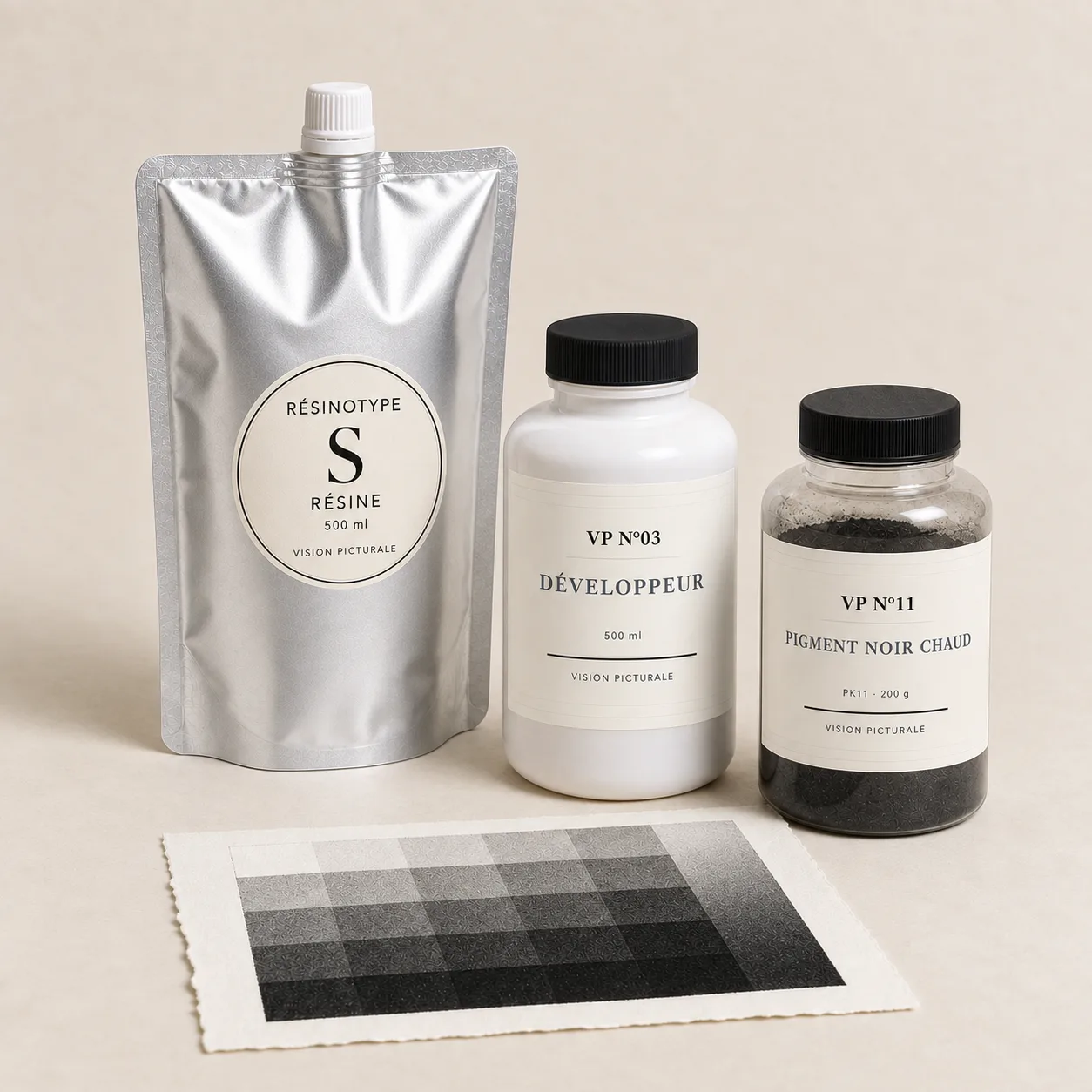
Maison Picturale · Paris 20e