Alternative process
AdvancedBromoil
Between painting and photography
VP Bromoil is a process where a gelatin matrix, exposed and developed, is rehumidified then inked with a foam roller using black Charbonnel intaglio ink. Tanned areas accept ink while water-swollen areas repel it. Each roller pass reveals the image a little more. The result sits between oil painting and photography.
The art of inking
Bromoil is a process from the early days of photography. The softness and painterly quality of the prints are typical of this genre. Pictorialist photographers used it to affirm photography as a true art form. The VP kit eliminates all the toxic chemistry of the old process: no more silver bleaching, no more copper sulfate.
Materials
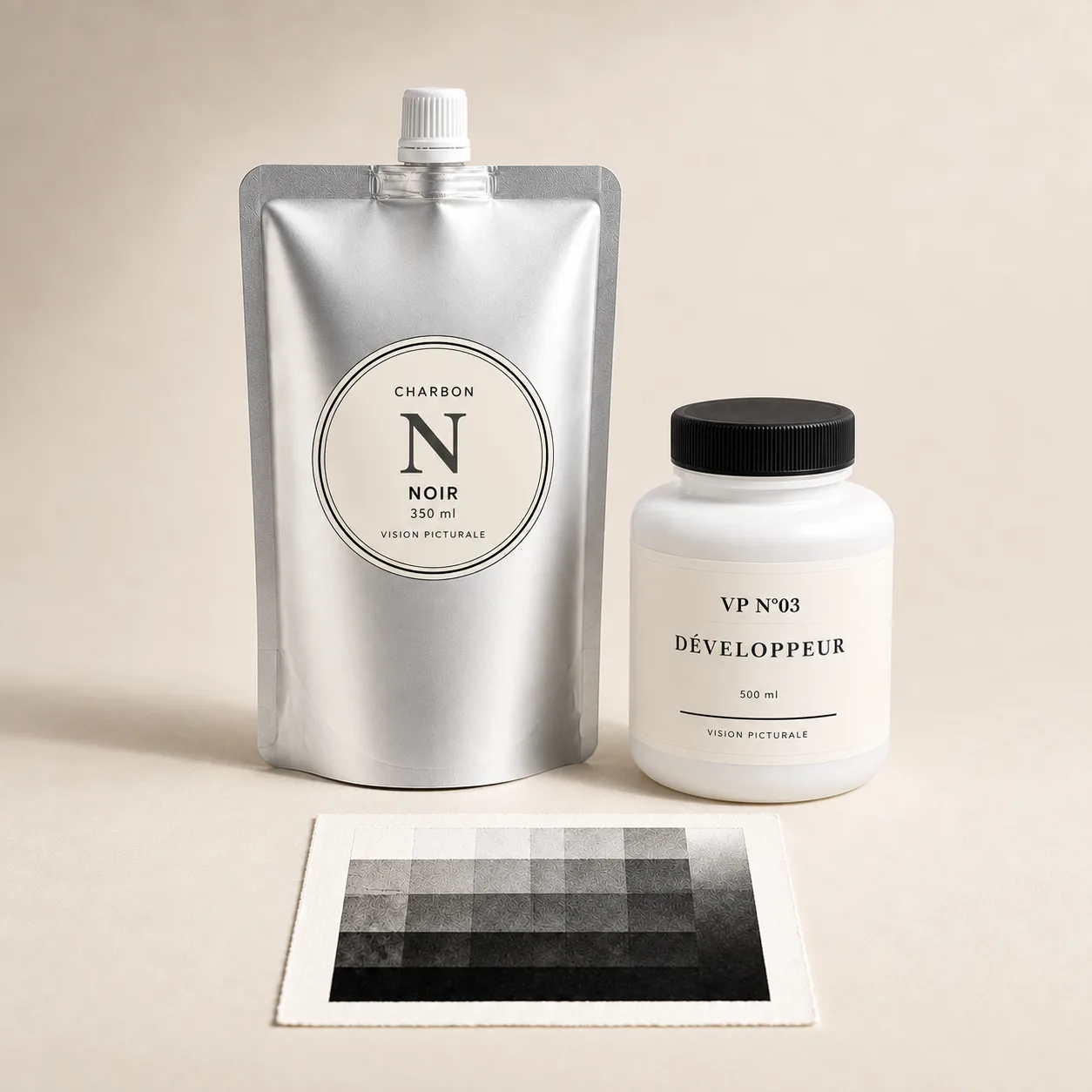
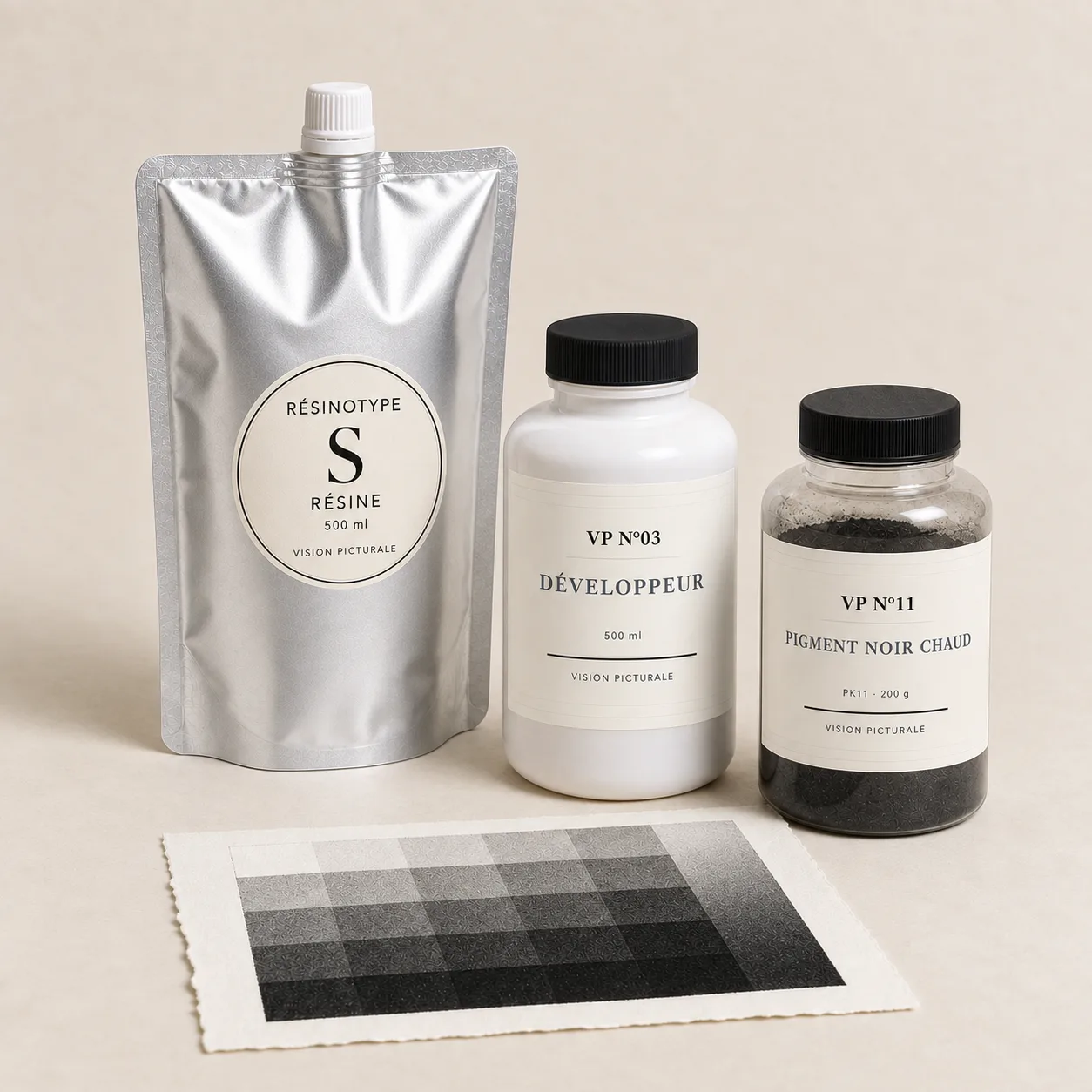
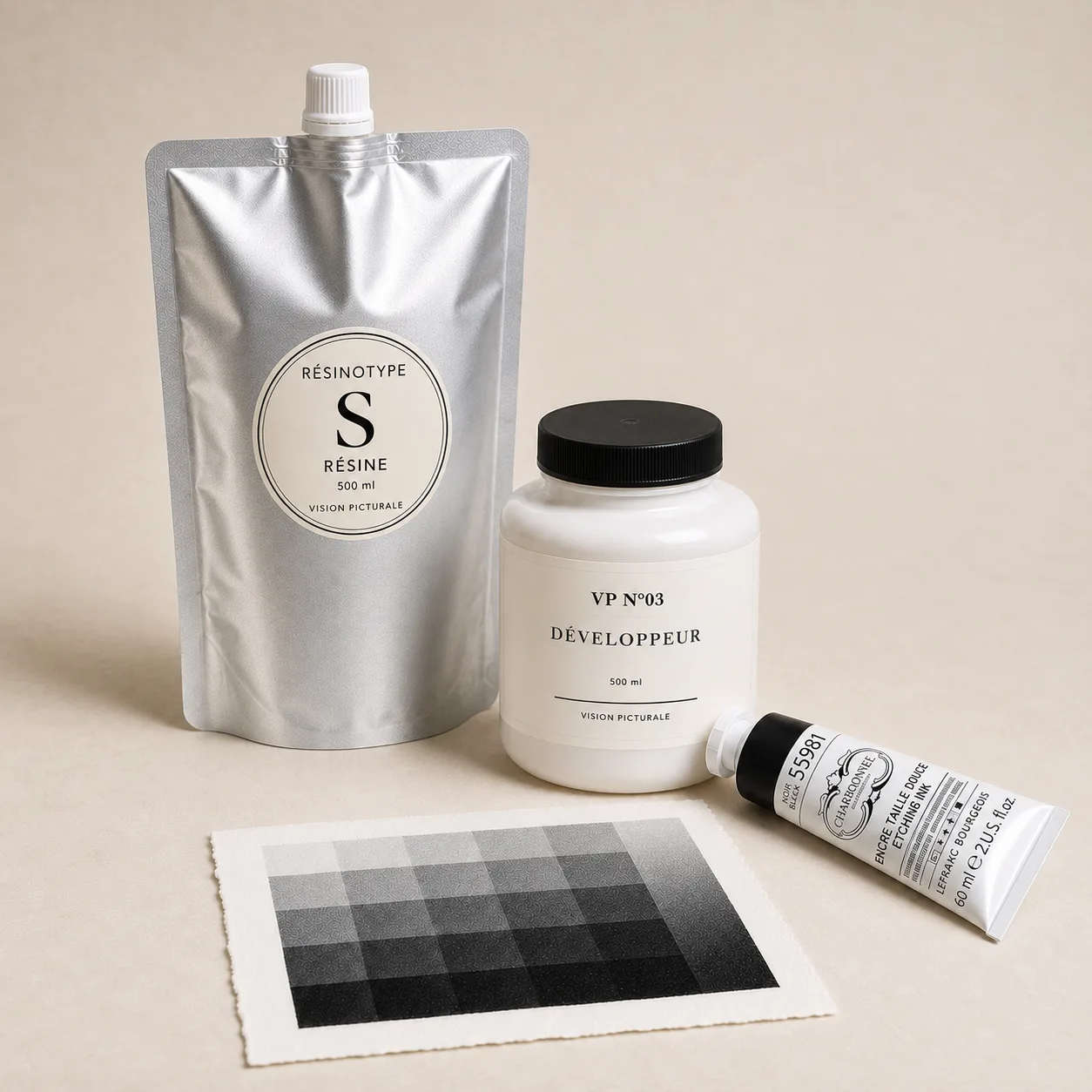
640 gsm watercolour paper · Resin pouch — S (pre-sensitised gelatine) · VP N°03 Developer · VP N°13 Charbonnel Pigment · Foam roller
Working guidance
Read the safety information for each product, prepare your workspace and use the indicated protection before handling it.
The supports
What we print on
Every process is contact-printed on an absorbent support. PULPØ 900 gsm is the studio’s own — smooth, heavy, ready to use. Standard watercolour papers also work, once primed.
See the supports in the shop- PULPØ — 900 gsm · 25 × 35 cm (10 sheets)
- Ready to use, no primer needed. Smooth 900 gsm support in its actual 25 × 35 cm format.
- Watercolour Paper 300 gsm — A4
- The everyday weight. Universal Primer is required.
- Watercolour Paper 640 gsm — A4
- The heavy weight, no cockling. Universal Primer is required.
- VP N°04 — Universal Primer
- Required with 300 and 640 gsm watercolour papers. Mark “I already have it” if you own some.
Makes watercolour papers usable
In 4 steps
Ink a bromoil in 4 steps
Prepare
Prepare your gelatin-coated sheets (glass plate, bain-marie, syringe, comb, drying).
Calibrate
Generate your negative countertype and print it on transparent film.
Expose
Expose with the Luminograph (2 min), develop with VP N°03 developer (3 min), then rehumidify 10 min at 20°C.
Reveal
Ink with a foam roller using VP N°13 Charbonnel Pigment. Alternate water and inking until you reach the desired result.
The signature gesture
The foam roller: the mechanics of bromoil inking
Bromoil isn't a print you develop — it's a print you paint. Once the gelatin matrix is exposed, developed and rehumidified, you hold an apparently uniform sheet. The image only appears the moment you pass the foam roller loaded with black Charbonnel ink.
The principle is simple in theory: areas tanned by light (image shadows) absorb water slowly and accept oily ink; water-swollen areas (highlights) repel it. The artist's hand decides how much ink to deposit, at what angle, with what pressure, in what order.
In practice, it's a dialogue. First light pass across the whole surface: a ghost image appears. You dab dry with a sponge. Second firmer pass on pure shadows, cross-hatched movement. Third selective pass on areas you want to densify. Each artist develops their own gestural signature after a few prints.
That's why two bromoils made from the same negative by two different people will always be recognizably different. And it's also why a bromoil never reproduces identically, even by its own author. This unpredictability is the absolute opposite of inkjet — and it is its raison d'être.
Frequently asked questions
Everything about this process
What is the origin of bromoil?
Bromoil is a pictorialist process developed in the early 20th century, formalized in 1907 by C. Welborne Piper and popularized by Briton E.J. Wall in his book The Bromoil Process published in London. Historic bromoil relied on a silver gelatin matrix bleached with cupric dichromate, a toxic salt today classified as CMR by ECHA. Bromoil Vision Picturale completely removes silver bleaching: the matrix uses gelatin sensitized by Universal Sensitizer and revealed by VP N°03 developer, then inked with black pigmented Charbonnel intaglio ink. The practitioner obtains the characteristic pictorial rendering of bromoil, between oil painting and photography, without handling toxic salts. The process remains editable for several hours after re-humidification.
What are the steps of a bromoil print?
A bromoil Vision Picturale print follows a strict six-step sequence. The gelatin matrix sensitized with the sensitizer is exposed under a 395-400 nm Luminograph A4 unit for two minutes depending on negative density. Development in diluted VP N°03 developer lasts three minutes at 20°C, followed by a five-minute rinse in running water. The matrix is then flat-dried and re-humidified by immersion in water at 20°C for ten minutes, a critical step that reveals the swelling differential between exposed and unexposed zones. Foam roller inking with black Charbonnel intaglio ink deposits pigment on dry swollen areas and spares the wet ones. The practitioner can adjust density by successive passes over several hours. Final drying takes twenty-four hours.
How does bromoil differ from carbon transfer?
Bromoil Vision Picturale and carbon transfer share gelatin but answer different artistic intentions. VP bromoil, with its gelatin matrix sensitized by the sensitizer and revealed by VP N°03, is inked with a foam roller using Charbonnel intaglio ink after re-humidification. It remains editable for several hours and allows manual intervention by the practitioner on each zone, comparable to an engraver working a plate. VP carbon transfer, based on pigmented gelatins ready to expose after sensitization with VP N°03, fixes the image definitively at transfer without retouching. Carbon transfer offers the highest dMax among alternative processes and a superior multi-century permanence. The practitioner will choose bromoil for interpretation and gesture, carbon transfer for archival depth and maximum tonal range.
What skill level does bromoil require?
Bromoil Vision Picturale sits at a confirmed intermediate level and is not recommended as a first alternative process. Foam roller mastery demands fine coordination between pressure, speed, and angle, comparable to learning intaglio engraving. The practitioner should have completed at least twenty cyanotype prints and ten Aquaprint prints beforehand to understand sensitization, Luminograph exposure, and VP N°03 development. Ten-minute re-humidification at 20°C requires precise control: too short, the matrix won't accept ink; too long, the differential vanishes. The Bromoil box supplies the Resin pouch, the VP N°03 developer and VP N°13 — Pigment Charbonnel, the black intaglio ink. The practitioner only adds a 100 mm high-density foam roller and a marbling glass plate.
How permanent is a bromoil print?
A bromoil Vision Picturale print presents excellent archival quality, estimated at several centuries. The black Charbonnel intaglio ink used for inking is a pigmented ink with linseed oil binder rated maximum permanence by manufacturer Lefranc Bourgeois, historic supplier since 1862 to European engravers. The carbon black pigment forming Charbonnel black is chemically inert and UV-resistant. The underlying matrix, gelatin hardened by Universal Sensitizer, is as stable as classic silver matrices. The practitioner must ensure complete drying of twenty-four to forty-eight hours before handling, and mounting on neutral pH 7 to 8.5 board. Pictorialist bromoil prints from the early 20th century English school, preserved at the Royal Photographic Society Collection in London, attest to stability exceeding one hundred and twenty years.
Chemistry kit
Bromoil
VP Bromoil is a process where a gelatin matrix, exposed and developed, is rehumidified then inked with a foam roller using black Charbonnel intaglio ink. Tanned areas accept ink while water-swollen areas repel it. Each roller pass reveals the image a little more. The result sits between oil painting and photography.
An alternative
Want a bromoil, not ink it yourself?
The printers of Maison Picturale produce bromoils on commission in their Paris atelier, with Charbonnel intaglio ink on 640 gsm cotton paper. Each print is hand-inked, gestural signature included. Vision Picturale supplies the kit to practice the gesture; Maison Picturale signs the final work.
Order a bromoilMaison Picturale · Paris 20e