A historic process
Invented in 1842 by Sir John Herschel, cyanotype uses two iron salts that become photosensitive when mixed. Exposed to UV light — sunlight or Luminograph — it reveals a monochrome image in intense blue. Anna Atkins used it to create the first book illustrated by photography.
Materials
100% cotton watercolour paper 640 gsm · VP N°01 + VP N°02 emulsion · Wide brush · UV light
Working guidance
Read the safety information for each product, prepare your workspace and use the indicated protection before handling it.
The supports
What we print on
Every process is contact-printed on an absorbent support. Standard watercolour papers work very well, once coated with the Universal Primer.
See the supports in the shop- Watercolour Paper 300 gsm — A4
- The everyday weight. Universal Primer is required.
- Watercolour Paper 640 gsm — A4
- The heavy weight, no cockling. Universal Primer is required.
- VP N°04 — Universal Primer
- Required with 300 and 640 gsm watercolour papers. Mark “I already have it” if you own some.
Makes watercolour papers usable
In 4 steps
Make a cyanotype in 4 steps
Prepare
Mix VP N°01 and VP N°02 solutions in equal parts, then coat the paper with a brush.
Calibrate
Print your negative on transparent film using the provided ICC profiles.
Expose
Place the negative in contact on the sensitized paper and expose 5-15 min with the Luminograph.
Reveal
Rinse under running water for 5 minutes. The Prussian blue gradually appears.
Sunlight or Luminograph?
Cyanotype in sunlight vs Luminograph: which exposure time?
Cyanotype can be exposed in sunlight — that's part of its historic charm. But the November sun in Paris is nothing like the July sun: times vary from 5 minutes to over an hour for the same emulsion, the same paper, the same negative.
Under direct summer sun (12 PM to 2 PM, clear sky), count 5 to 8 minutes. Under low winter sun, count 25 to 45 minutes — and the result remains unpredictable: a passing cloud cuts exposure by 60%. For reproducible work, it's unusable.
The Luminograph solves this by delivering a constant UV dose: 8 minutes on the Luminograph A4 equals a sunny summer day, cloudless, windless, at 2 PM sharp. You test once, note the time, and reuse it identically three months later.
Our recommendation: start in sunlight to understand the process's sensitivity (and enjoy the magic of outdoor printing), then switch to the Luminograph when you want to produce a coherent series — a portrait, an artist book, a botanical sequence. The two approaches are complementary, not opposed.
Frequently asked questions
Everything about this process
What is the cyanotype process?
The cyanotype is a monochrome blue photographic process invented by Sir John Herschel in 1842 and popularized from 1843 by botanist Anna Atkins in her book Photographs of British Algae, considered the first book illustrated with photography. The cyanotype relies on the photosensitivity of a mixture of ferric ammonium citrate and potassium ferricyanide: under UV-A exposure, iron III reduces to iron II and forms insoluble Prussian blue. The Vision Picturale kit uses VP N°01 (iron salts) and VP N°02 (ferricyanide) in equal parts, applied with a brush onto 100% cotton watercolor paper at 640 gsm without optical brighteners. After drying, the paper is exposed under a negative, then rinsed for five minutes in running water, with no chemical fixer required. The image reveals itself during final drying: a Prussian blue monochrome with clean, bright whites.
How long does a cyanotype print take?
A Vision Picturale cyanotype print requires roughly one hour and thirty minutes from start to finish, excluding final drying time. Brush sensitization takes five minutes for an A4 sheet, followed by twenty to thirty minutes of dark drying depending on ambient humidity. UV exposure under the Luminograph A4, a 395-400 nm UV-A unit placed thirty centimeters from the paper, lasts five to fifteen minutes depending on negative density; under midday summer sun in southern France, three to eight minutes are sufficient. Running-water rinsing takes five minutes, until the water runs clear and unexposed areas return to white. Final flat drying on a rack requires two to four hours. The practitioner can comfortably complete three to four prints in a single morning by parallelizing exposure and rinsing across multiple sheets of cotton paper.
Cyanotype or Aquaprint for beginners?
The cyanotype is preferable to Aquaprint for beginners in alternative photography because it requires only a single coating layer, against one to four successive layers for CMYK Aquaprint. The cyanotype tolerates exposure variations of several minutes without visible degradation, whereas gum demands a precise two to five minute exposure window per layer. Material cost is also lower: one set of VP N°01 and VP N°02 bottles yields about thirty A4 prints, against roughly ten for a full Aquaprint kit. The beginner obtains a readable, stable image from the very first print, with no powdered pigment handling and no warm-water clearing at 40°C. The cyanotype therefore remains the historical and pedagogical entry point Vision Picturale recommends before tackling gum bichromate, carbon transfer, or resinotype, all of which assume mastered coating habits.
What equipment does cyanotype require?
The cyanotype requires no prior expertise and is the most accessible alternative process for beginners, succeeding on the first or second attempt in most cases. Beyond the VP N°01 and VP N°02 chemistry kit, the practitioner needs 100% cotton watercolor paper at 640 gsm without optical brighteners, a 50 mm synthetic flat brush, a plastic rinsing tray, nitrile gloves, and a digital negative printed on inkjet transparency film. For weather-independent, repeatable exposures, the Luminograph A4 at 449 euros or A3+ at 699 euros, a 395-400 nm UV-A unit designed by Vision Picturale, guarantees consistent five to fifteen minute exposure times. A hinged contact printing frame improves negative-to-paper contact. Total starting budget excluding the kit itself stays under one hundred euros, making cyanotype the most affordable structured entry into hand-coated photographic printing today.
How long does a cyanotype print last?
A correctly rinsed cyanotype print stored away from direct light lasts roughly one hundred to one hundred fifty years according to conservation studies conducted by the Library of Congress and the Image Permanence Institute in Rochester. The Prussian blue formed during exposure is chemically stable, but sensitive to alkaline environments: prolonged contact with non-neutral cardboard or basic mat boards causes progressive fading and bleaching of the image. The practitioner must therefore mount cyanotype prints onto certified pH-neutral boards such as Canson Conservation or museum-grade equivalents. Reactivation through a mild bath of water lightly acidified with lemon juice can restore a faded cyanotype to near-original density. This permanence remains lower than the carbon transfer process, which exceeds several centuries, yet remains entirely sufficient for exhibition use and standard private collection contexts worldwide.
An alternative
Want a cyanotype print, not make it yourself?
The artisans of Maison Picturale, a Paris atelier-gallery, produce cyanotype prints on commission from your file or from their catalogue. Hand-printed on 100% cotton paper, formats up to Jésus (56 × 76 cm). Vision Picturale supplies the kit; Maison Picturale supplies the finished, signed work.
Order a cyanotype print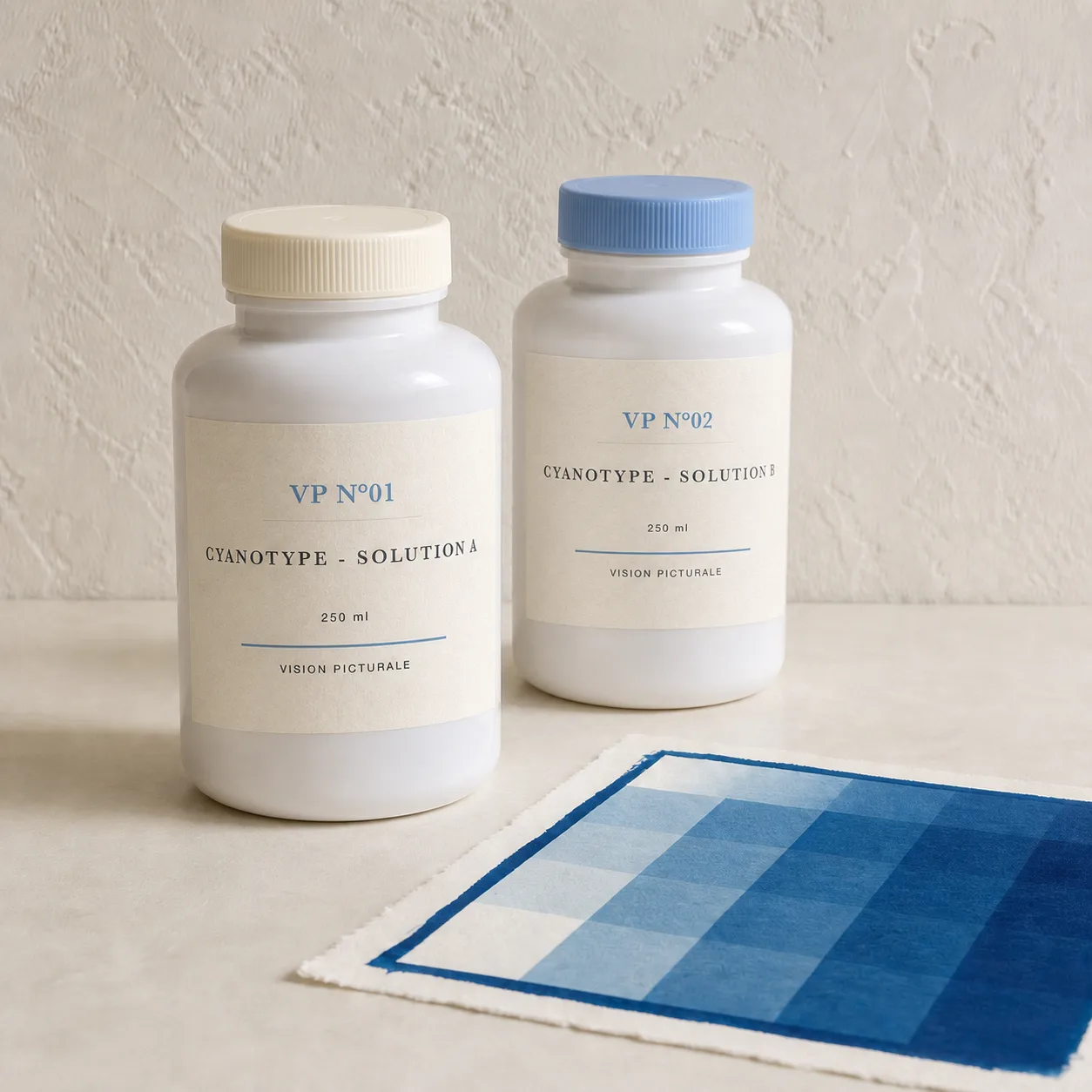
Maison Picturale · Paris 20e