Aquaprint CMYK Box — Watercolour
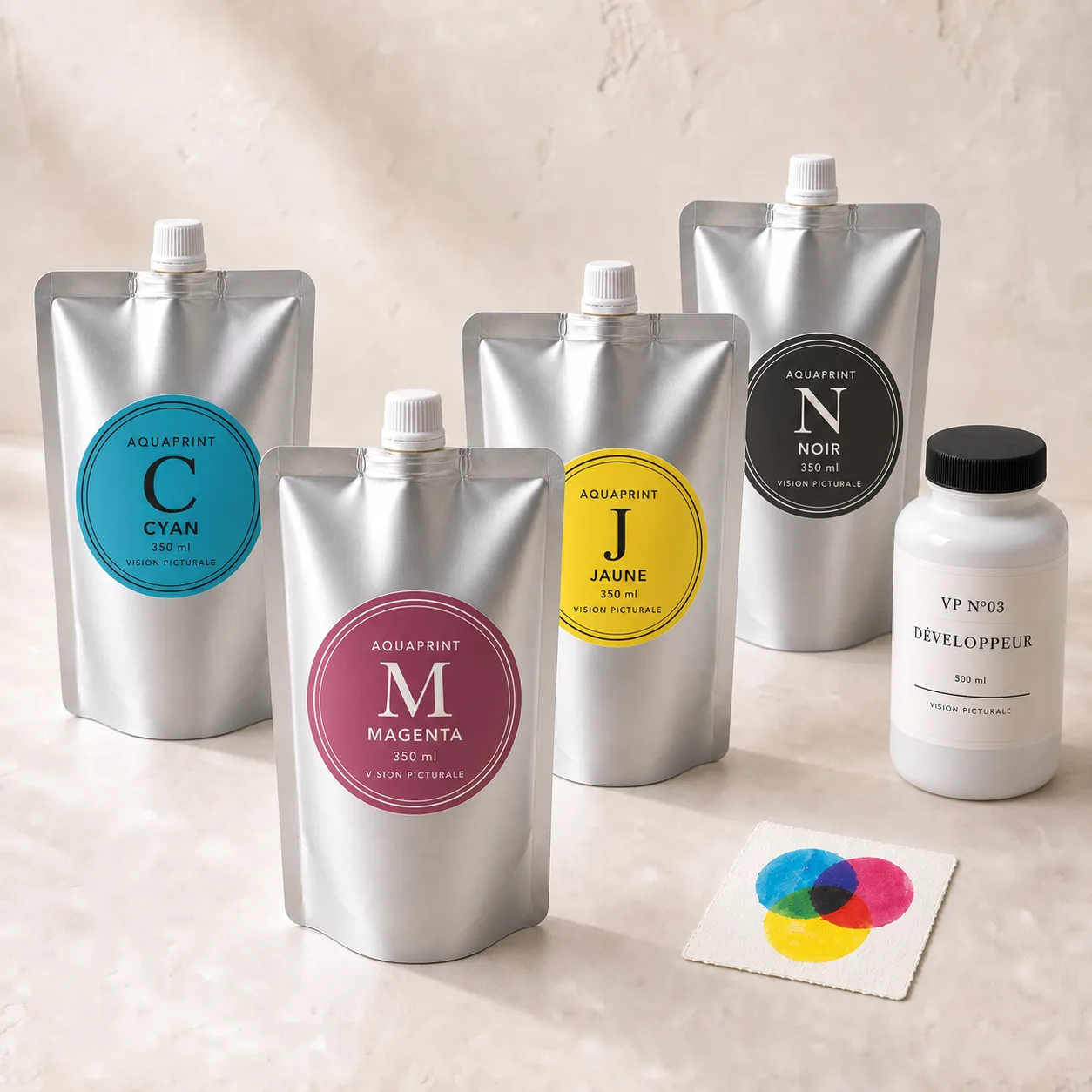
Aquaprint CMYK: four pigment pouches, VP N°03 Developer and one complimentary PULPØ sheet. Add-ons are chosen in Build your kit. Aquaprint, the perfect compromise between gum bichromate and carbon printing — the painterly matter of gum, the depth of carbon, without dichromate.
In production
This product is shown, but is not available to buy yet.
14-day returns
Secure checkout via Shopify
Compose your workspace
The printing chain, step by step. What the boxed set contains is marked, the rest can be added — or ticked “I already have it”.
Complete workspace
1/5 steps
Format
The recommended workshop for this kit
Luminograph A4 · Starter Kit · PULPØ — 900 gsm · 25 × 35 cm (10 sheets) · HD Negative Film — A4
1 year of Calibration Flow Pro included with the Luminograph. Daylight works too, with experience: every line can be unticked, or marked “I already have it” — except the Primer, which comes with watercolour papers.
01 · Chemistry — included in this boxed set
114 pouches of pre-sensitised mixture, 350 ml each, ready to pour — nothing to add.
- PB15:3
Cyan — pouch C
- PR122
Magenta — pouch M
- PY155
Yellow — pouch J
- PBk7
Black — pouch N
- 500 ml
VP N°03 — Developer
1 complimentary PULPØ 900 gsm sheet
- ——
- ——
- ——
- ——
- ——
02 · Support
4- ——
- Needs Primer N°04Needs Primer N°04
- Needs Primer N°04Needs Primer N°04
- ——
03 · Negative
1- ——
04 · UV exposure
1- ——
05 · Studio tools
1- ——
Watercolour papers must be primed before sensitising, so Universal Primer N°04 comes with them. It is not on sale yet: mark it “I already have it” if you own some, and these papers open up — or choose PULPØ, which needs none.
Success guarantee
A boxed set on its own, for an equipped studio.
We sell a chemistry kit on its own to studios that can succeed with it: a Luminograph, or the experience and equipment you tell us about. Nothing to prove — one box to tick.
No Luminograph yet? Tell us where you stand:
Remembered on this device.
Selection total
€79
1 × Aquaprint CMYK
What you can create
Process guide
Find the steps, practical advice and safety information for this process in its dedicated guide.
Read the process guideAquaprint CMYK
€79
Compose your workspace
The printing chain, step by step. What the boxed set contains is marked, the rest can be added — or ticked “I already have it”.
Complete workspace
1/5 steps
Format
The recommended workshop for this kit
Luminograph A4 · Starter Kit · PULPØ — 900 gsm · 25 × 35 cm (10 sheets) · HD Negative Film — A4
1 year of Calibration Flow Pro included with the Luminograph. Daylight works too, with experience: every line can be unticked, or marked “I already have it” — except the Primer, which comes with watercolour papers.
01 · Chemistry — included in this boxed set
114 pouches of pre-sensitised mixture, 350 ml each, ready to pour — nothing to add.
- PB15:3
Cyan — pouch C
- PR122
Magenta — pouch M
- PY155
Yellow — pouch J
- PBk7
Black — pouch N
- 500 ml
VP N°03 — Developer
1 complimentary PULPØ 900 gsm sheet
- ——
- ——
- ——
- ——
- ——
02 · Support
4- ——
- Needs Primer N°04Needs Primer N°04
- Needs Primer N°04Needs Primer N°04
- ——
03 · Negative
1- ——
04 · UV exposure
1- ——
05 · Studio tools
1- ——
Watercolour papers must be primed before sensitising, so Universal Primer N°04 comes with them. It is not on sale yet: mark it “I already have it” if you own some, and these papers open up — or choose PULPØ, which needs none.
Success guarantee
A boxed set on its own, for an equipped studio.
We sell a chemistry kit on its own to studios that can succeed with it: a Luminograph, or the experience and equipment you tell us about. Nothing to prove — one box to tick.
No Luminograph yet? Tell us where you stand:
Remembered on this device.
Selection total
€79
1 × Aquaprint CMYK
What you can create
Need advice?
Our team can help you choose the right product for your project.
Process guide
Find the steps, practical advice and safety information for this process in its dedicated guide.
Read the process guideLearn more
The four-color Aquaprint rebuilds the image by superimposing four CMYK pigment layers, in direct lineage with the gum bichromate prints of Robert Demachy and Constant Puyo at the turn of the twentieth century. Each layer, cyan, magenta, yellow, black, is exposed 2 to 5 minutes, then cleared in 40 °C warm water that selectively dissolves the unexposed gum. The result marries the texture of cotton paper with soft, slightly faded colors typical of Pictorialist photography. Unlike the Sanguine and Monochrome variants, printed from a single separation negative, this kit handles precise registration of four successive layers and demands absolute geometric rigor at each application, layer after layer.
The VP reformulation completely removes potassium dichromate, the toxic backbone of historical gum printing, in favor of a pre-sensitized gum and CMYK powder pigments dosed via 1.25 to 15 mL measuring spoons. Application combines brush for texture and foam roller for uniformity, followed by development in diluted VP N°03 developer then clearing at 40 °C. It is today the only dichromate-free four-color alternative kit available, while the monochrome variants of the VP catalog require only one to three layers. Practiced in your kitchen, with no darkroom and no ventilated lab, despite the complexity of multi-pass color registration across four successive coatings.