
A photogram is a photograph made without a camera. Objects are laid directly on a light-sensitive surface, exposed, developed: their silhouette remains. No lens, no focusing, no negative — the object is the negative. It is the photographic gesture reduced to its minimal proposition: something intercepted light, and that interception left a trace.
Before the camera, there was contact
The history of photography is told as the history of a machine, yet it begins with a gesture that needs no machine. As early as 1834, before fixing anything inside a camera obscura, William Henry Fox Talbot laid leaves and lace on silver-salt paper and left them in the sun. He called these images photogenic drawings. They predate the camera.
Nine years later, Anna Atkins published what is held to be the first book illustrated with photographs: Photographs of British Algae: Cyanotype Impressions, whose first part appeared in October 1843. Every plate is a cyanotype photogram — an alga laid on iron-salt paper, exposed to sunlight, rinsed in water. The process had been published by John Herschel just a year earlier. In other words: the first photographic book in history is a book of photograms, and they are cyanotypes.
The twentieth century rediscovered the gesture as a plastic form — Christian Schad from 1918, then Man Ray and László Moholy-Nagy from 1922, each renaming the process after himself. The mechanics, however, have not shifted a millimetre since Atkins.
One variable only: opacity
Everything at stake in a photogram comes down to one question: how much light does this object let through, and where? There is no aperture, no focal length, no depth of field. There is a UV source, an object, a sheet of paper — and the degree to which one stops the other.
This is why frankly opaque objects disappoint quickly. A key, a pebble, a pair of scissors: you get a perfectly crisp white silhouette, and nothing else. The image is a stencil. What gives a photogram its richness are the intermediate values — and they exist only where the material modulates light instead of blocking it.
- A leaf is thicker along its veins than between them: it inscribes its own network, in gradation.
- A feather lets light through between each barb: it becomes a veil, not a cut-out.
- A dried citrus slice modulates across its whole surface — it is almost a negative in itself.
- Lace, tulle, etched glass, wild grasses: same principle — draw with what is passed through.
Sharpness depends on no optics at all
This is the least intuitive thing about the process, and the only one that genuinely causes failures. Under an enlarger, sharpness is a matter of optics. In a photogram it is a matter of distance, and nothing else: the gap between object and paper. One millimetre is enough for UV to diffuse sideways under the object's edge and turn a clean outline into soft shadow.
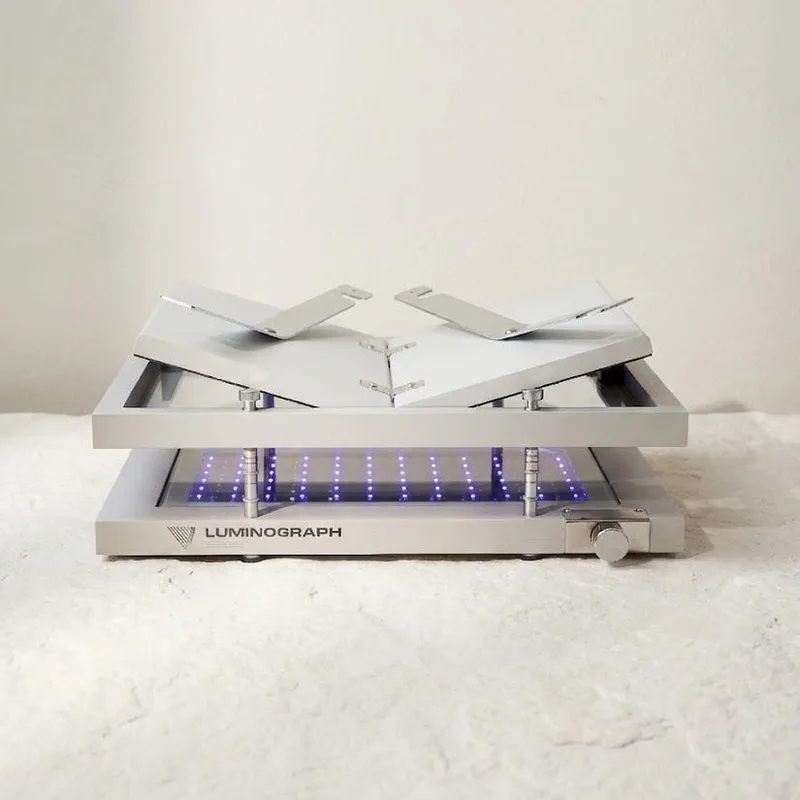
Hence the importance of the glass plate, which is not an accessory but the central tool. And hence three causes of blur, always the same: a fresh leaf curling as it dries during exposure; an object too thick, lifting the pane and unsticking the whole composition; or simply no glass at all. That said, the blur is only a fault if it was not chosen: the graded penumbra under an undulating leaf is an effect many seek deliberately.
The photogram is the best way into cyanotype
A conventional cyanotype print requires a digital negative: an inverted image, printed on transparency film, with a correction curve. That is the step that discourages people, because it calls for a computer, a printer and a calibration.
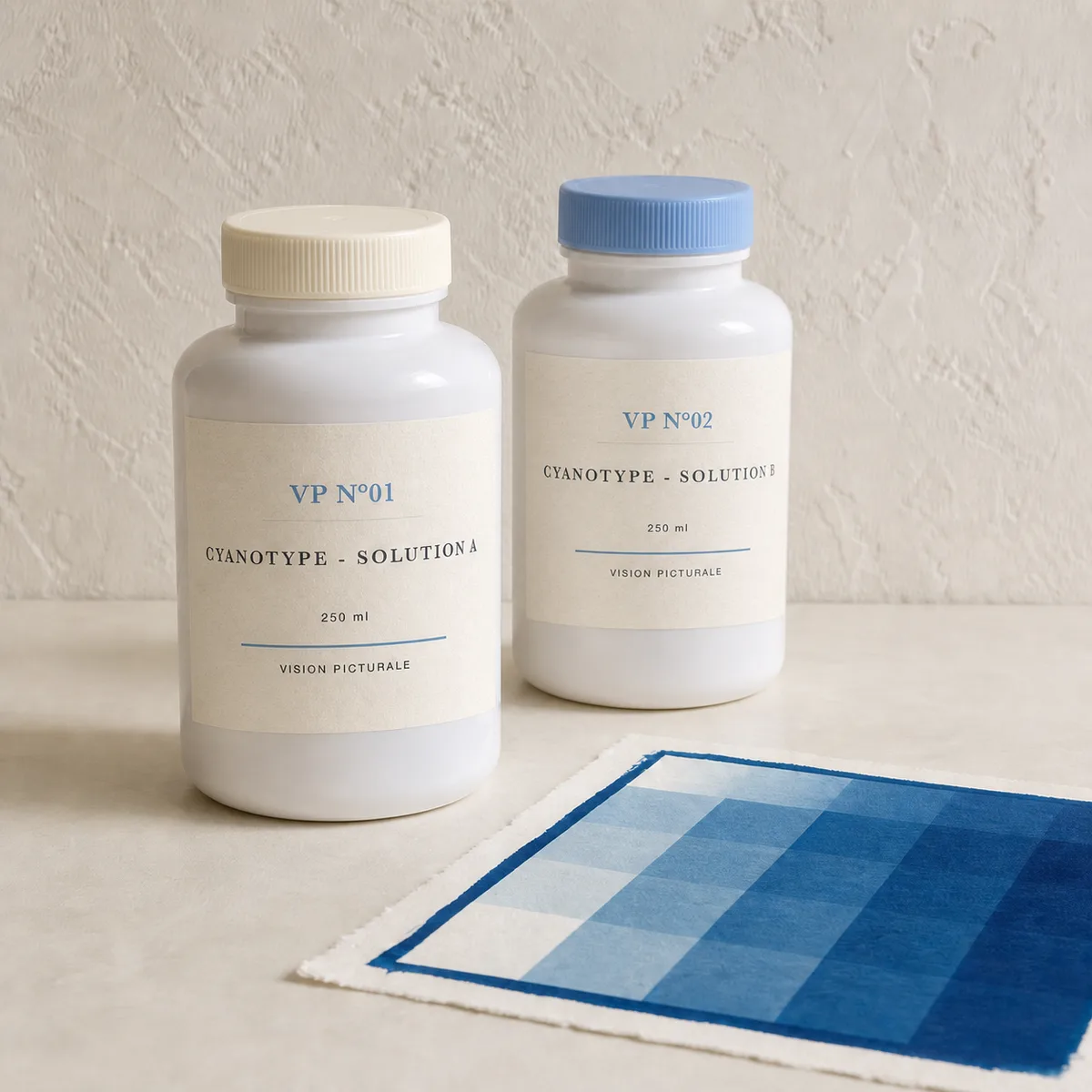
The photogram removes that step entirely. What remains is chemistry and light — that is to say, the core of the process. The cyanotype kit supplies the sensitizing chemistry; the only thing left to get is 100% cotton watercolor paper, sold separately. Coat, dry, lay down some leaves, expose, rinse. An afternoon is enough, and you will have learned in one go what the sensitizer does, how an exposure reads by eye, and what the rinse reveals.
It is also, incidentally, the only photographic process you can practise alongside a child while watching nothing more hazardous than a sheet of glass.
Tristan Sidem & Raphaël Lebas de Lacour — Vision Picturale