Carbon Mono Box — Museum Black
Carbon Mono kit in production, shown but not sold. Carbon transfer is the summit of pigment printing; Aquaprint gives you its essence today, without dichromate.
In production
This product is shown, but is not available to buy yet.
14-day returns
Secure checkout via Shopify
Compose your workspace
The printing chain, step by step. What the boxed set contains is marked, the rest can be added — or ticked “I already have it”.
Complete workspace
1/5 steps
Format
The recommended workshop for this kit
Luminograph A4 · Starter Kit · PULPØ — 900 gsm · 25 × 35 cm (10 sheets) · HD Negative Film — A4
1 year of Calibration Flow Pro included with the Luminograph. Daylight works too, with experience: every line can be unticked, or marked “I already have it” — except the Primer, which comes with watercolour papers.
01 · Chemistry — included in this boxed set
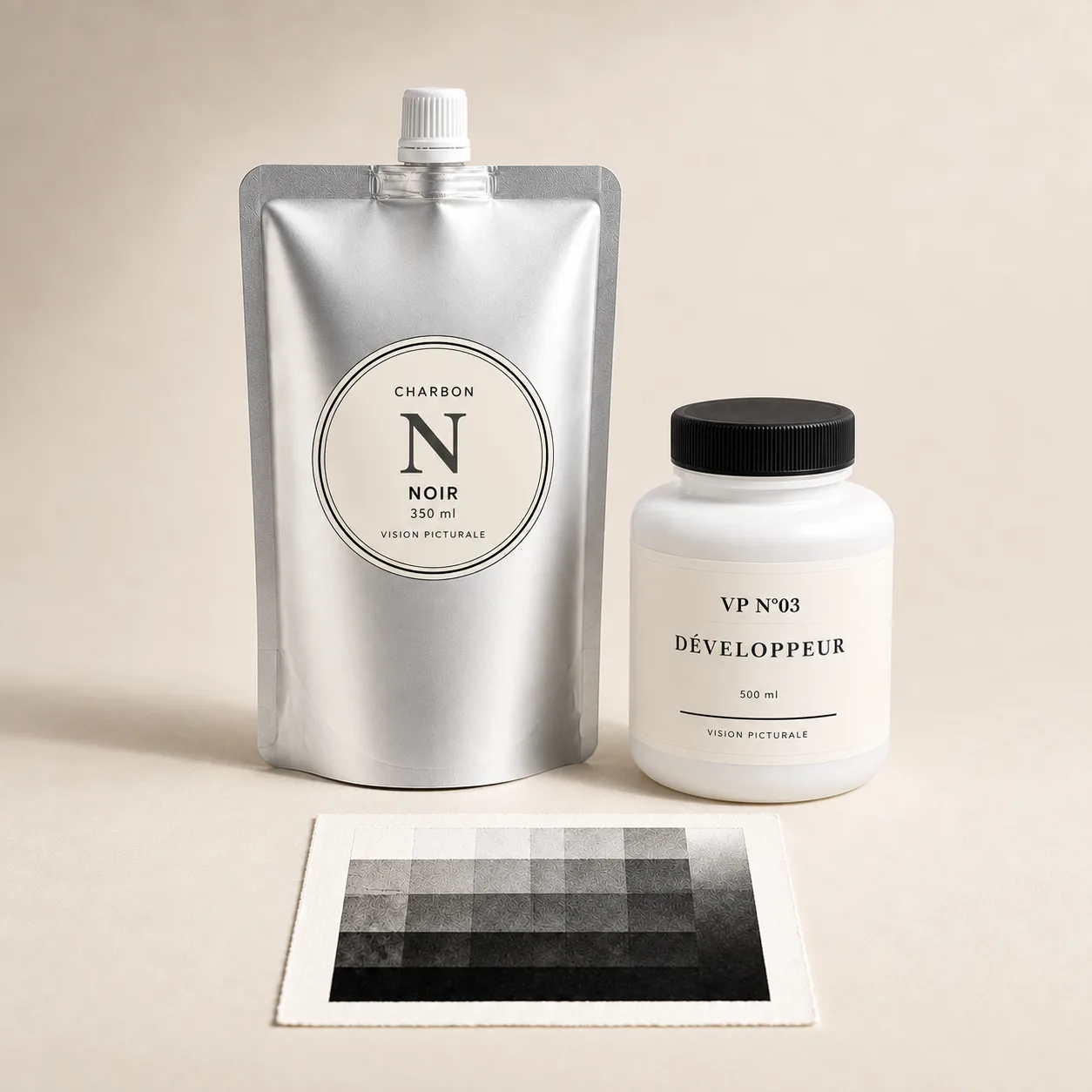
21 pouch of pre-sensitised mixture, 350 ml, ready to pour — nothing to add.
- PBk7
Black — pouch N
- 500 ml
VP N°03 — Developer
02 · Support
4- ——
- Needs Primer N°04Needs Primer N°04
- Needs Primer N°04Needs Primer N°04
- ——
03 · Negative
1- ——
04 · UV exposure
1- ——
05 · Studio tools
1- ——
Watercolour papers must be primed before sensitising, so Universal Primer N°04 comes with them. It is not on sale yet: mark it “I already have it” if you own some, and these papers open up — or choose PULPØ, which needs none.
Success guarantee
A boxed set on its own, for an equipped studio.
We sell a chemistry kit on its own to studios that can succeed with it: a Luminograph, or the experience and equipment you tell us about. Nothing to prove — one box to tick.
No Luminograph yet? Tell us where you stand:
Remembered on this device.
Selection total
Price to come
1 × Carbon Mono
What you can create
Process guide
Find the steps, practical advice and safety information for this process in its dedicated guide.
Read the process guideCarbon Mono
Price to come
Compose your workspace
The printing chain, step by step. What the boxed set contains is marked, the rest can be added — or ticked “I already have it”.
Complete workspace
1/5 steps
Format
The recommended workshop for this kit
Luminograph A4 · Starter Kit · PULPØ — 900 gsm · 25 × 35 cm (10 sheets) · HD Negative Film — A4
1 year of Calibration Flow Pro included with the Luminograph. Daylight works too, with experience: every line can be unticked, or marked “I already have it” — except the Primer, which comes with watercolour papers.
01 · Chemistry — included in this boxed set
21 pouch of pre-sensitised mixture, 350 ml, ready to pour — nothing to add.
- PBk7
Black — pouch N
- 500 ml
VP N°03 — Developer
02 · Support
4- ——
- Needs Primer N°04Needs Primer N°04
- Needs Primer N°04Needs Primer N°04
- ——
03 · Negative
1- ——
04 · UV exposure
1- ——
05 · Studio tools
1- ——
Watercolour papers must be primed before sensitising, so Universal Primer N°04 comes with them. It is not on sale yet: mark it “I already have it” if you own some, and these papers open up — or choose PULPØ, which needs none.
Success guarantee
A boxed set on its own, for an equipped studio.
We sell a chemistry kit on its own to studios that can succeed with it: a Luminograph, or the experience and equipment you tell us about. Nothing to prove — one box to tick.
No Luminograph yet? Tell us where you stand:
Remembered on this device.
Selection total
Price to come
1 × Carbon Mono
What you can create
Need advice?
Our team can help you choose the right product for your project.
Process guide
Find the steps, practical advice and safety information for this process in its dedicated guide.
Read the process guideLearn more
Monochrome carbon transfer was invented by Briton Joseph Swan in 1864, and remains to this day the non-silver photographic process offering the highest density, the highest dMax of all alternative processes. The print shows a slight bas-relief visible in raking light, the physical signature of pigmented gelatin transfer onto cotton paper. Its archival permanence is measured in centuries, a claim no other process in the catalogue can make: neither gum, nor cyanotype, nor bromoil reaches this stability. It is explicitly the museum print process, designed for works destined for institutional collections or long-term heritage transmission across multiple generations of curators and conservators.
This kit is still being developed: it is shown, it is not sold, and its final composition is not settled. Vision Picturale displays it because it places everything else in the catalogue. Carbon transfer is the highest point of pigment printing, and Aquaprint is the path that gives you its essence today: the perfect compromise between gum bichromate and carbon printing — the painterly matter of gum, the depth of carbon, without dichromate. Anyone who wants a carbon print right now turns to the printers of Maison Picturale, who make it on request.