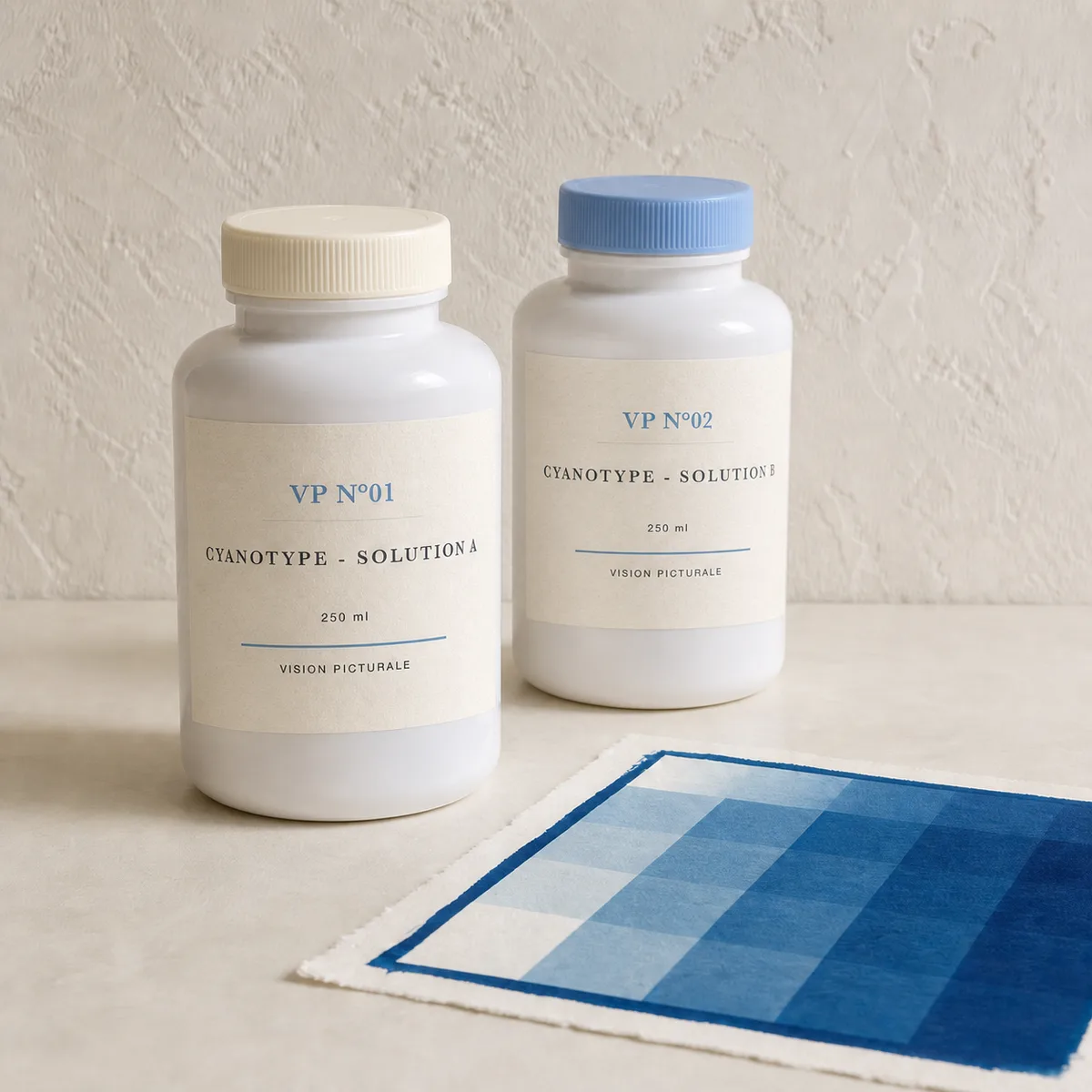

Two kits open the Vision Picturale catalog to beginners, and they do not tell the same story. On one side, the Coffret Cyanotype — Bleu Iconique (€39, Beginner level): cyanotype, the iron-based process invented by Sir John Herschel in 1842 and popularized from 1843 by Anna Atkins, which produces a Prussian blue monochrome with two bottles — VP N°01, ferric ammonium citrate, and VP N°02, potassium ferricyanide — and tap water. On the other, the Aquaprint family (€69 to €79 depending on the variant): the gum bichromate of Pictorialists Robert Demachy and Constant Puyo, reformulated by Vision Picturale without the potassium dichromate that made the historical process impossible to practice in a kitchen.
Two kits, two promises: what each box really holds
The difference is not a quality ranking but a difference in kind. Cyanotype is single-layer: one sensitization, one exposure, one rinse — the most direct entry-level process in the catalog. Aquaprint builds the image in layers of pigmented gum arabic: one for the Monochrome, three for the Sanguine, four for CMYK four-color, each exposed under UV then cleared in warm water at 40°C. Two different gestures, two different images — and two learning curves worth facing before you buy.
The real difficulty: one forgiving coat versus exposure windows
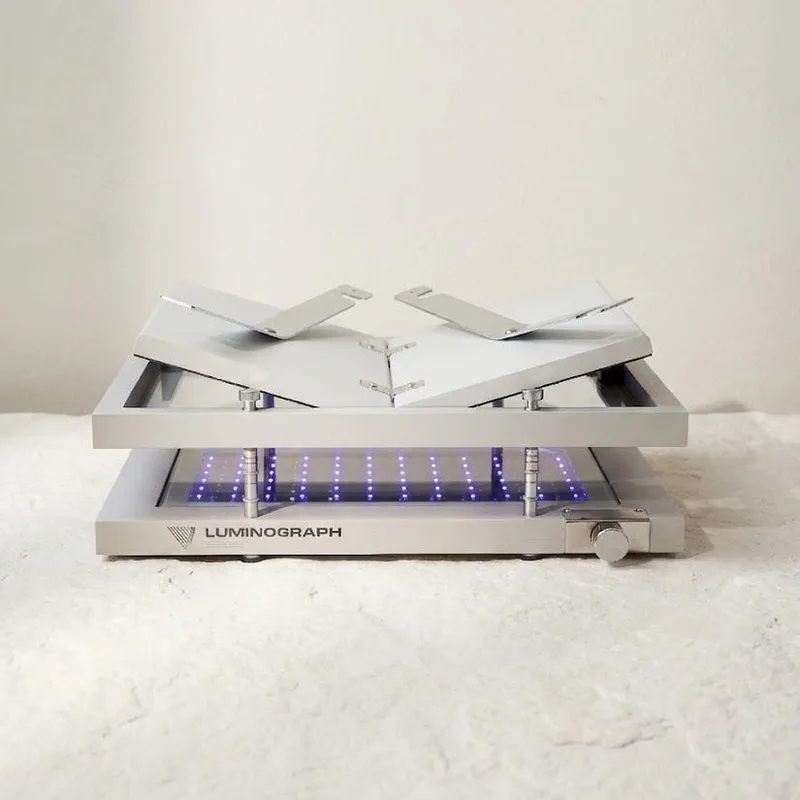
Cyanotype requires no prior expertise: it is the most accessible alternative process, succeeding on the first or second attempt in most cases. Its safety margin is real: it tolerates exposure variations of several minutes without visible degradation of the image. Exposure lasts 5 to 15 minutes under a 395-400 nm UV-A Luminograph placed 30 cm away, and development amounts to five minutes of rinsing in running water, with no chemical fixer. For learning the digital negative, brush coating and how to read an exposure, there is no better training ground.
Aquaprint, by contrast, demands precision. gum works within a 2 to 5 minute exposure window per layer: a negative too light or too dense ruins the coat. And the CMYK four-color variant adds the two constraints that define its confirmed intermediate level: millimetric registration of four separation negatives, and exposure control to within ten seconds. It is a process that rewards rigor — and punishes improvisation.
The nuance that changes everything: the three Aquaprint variants are not equally difficult. The black Monochrome (Coffret Aquaprint Mono — Aquarelle Photo) and the Sienna earth Sanguine are rated Beginner+ in the catalog: a single separation negative, a thirty-second exposure tolerance, approximate registration accepted between layers. Vision Picturale recommends them from advanced-beginner level, ideally after five to ten successful cyanotype prints. Four-color, on the other hand, is earned: fifteen to twenty single-pigment prints are the concrete preparation before tackling it.
The look: Prussian blue or painterly matter
Cyanotype produces an instantly recognizable image: deep blues against clean whites, with no intermediate tinted shades. The Prussian blue formed during exposure is an insoluble, chemically stable pigment, and this graphic rendering serves herbaria, architecture and portraits particularly well. But you must accept it as it is: cyanotype is a blue monochrome, and it will remain one. If that color speaks to you — it has carried the process since 1842 — it is a strength; if you dream of color or warm blacks, it is a limit.
Aquaprint is the tool of painterly matter: translucent layers of pigment on cotton paper, brushstrokes that stay legible, the soft, slightly faded colors typical of Pictorialist photography. Three paths are open. CMYK four-color rebuilds a color image faithful to the negative — it is the only non-toxic four-color gum print kit on the market. Sanguine plays on the transparency of red-brown, halfway between Renaissance drawing and photography. Monochrome seeks the velvety depth of carbon black, with a watercolor softness that industrial silver gelatin processes never managed to reproduce.
Framed in terms of the final image, the question becomes simple: do you want to hang a clean, graphic blue on the wall, or a painterly matter — warm, colored or velvety — where the hand's gesture remains visible? Neither answer is superior to the other; they simply do not make the same object. Rendering is also the one criterion in this comparison where budget and difficulty carry no weight: it is a matter of taste, and it should be settled before everything else.
Time and budget, in numbers
On time, cyanotype wins by a wide margin. A complete print takes about an hour and a half excluding final drying: five minutes of sensitization for an A4 sheet, twenty to thirty minutes of dark drying, five to fifteen minutes of exposure, five minutes of rinsing. By parallelizing exposure and rinsing, you can complete three to four prints in a morning. Aquaprint counts differently: each layer requires thirty minutes of dark drying, two to five minutes of exposure, ten seconds of development in diluted VP N°03 developer, clearing in warm water at 40°C, then two hours of drying before the next layer. A complete four-color A4 print represents eight to ten hours spread over two days.
On budget, the gap runs roughly one to two in both columns. The Coffret Cyanotype — Bleu Iconique costs €39, and one set of VP N°01 + VP N°02 bottles covers about thirty A4 prints. Aquaprint kits range from €69 (Coffret Sanguine, Coffret Aquaprint Mono — Aquarelle Photo) to €79 (Coffret Aquaprint CMJN — Couleur Aquarelle), for around ten prints per kit. Both require the same 640 gsm 100% cotton watercolor paper and nitrile gloves; Aquaprint adds transparent gesso for sizing and a foam roller. For cyanotype, the starting budget excluding the kit stays under one hundred euros, without a Luminograph.
One expense, however, is shared: the exposure infrastructure. Both processes use the same digital negative printed on transparency film — ICC profiles come with the kits — and the same UV source. Cyanotype can be exposed in sunlight to start, but times vary from five minutes to over an hour with the season; a Luminograph A4 (€449) brings reproducibility, and will then serve Aquaprint as-is, from the first monochrome attempt all the way to four-color.
Safety: two non-toxic processes, two glove nuances
On safety, the comparison is a deliberate draw: both kits are non-toxic and practicable in a kitchen, without an extraction hood or a mask. Cyanotype chemistry contains no dichromate, no silver salts and no volatile solvents; ferric ammonium citrate carries no health hazard pictogram on European safety data sheets, and potassium ferricyanide, despite its name, only releases cyanide in contact with hot strong acids — never under printing conditions. The process's one strict rule: never mix the baths with concentrated acidic household products.
Aquaprint starts from further away: historical gum bichromate relied on potassium dichromate, a hexavalent chromium salt classified CMR category 1B and banned for private individuals in France since 2018. The Vision Picturale reformulation removes it entirely in favor of the Universal Sensitizer, whose safety data sheet lists no carcinogenic or mutagenic pictogram; the VP N°03 developer is non-volatile and biodegradable, and clearing water goes down standard drains. The glove nuance remains: nitrile gloves are recommended during cyanotype coating against lasting skin stains, and when mixing powder pigments for Aquaprint. In both cases, you are protecting yourself from staining, not from poison.
The verdict, profile by profile
The verdict comes down to three profiles, and it is an honest one: neither kit is a bad choice, but there is a wrong order. Cyanotype is the historical and pedagogical gateway Vision Picturale recommends before tackling gum, carbon or resinotype; Aquaprint is the painterly destination that justifies the apprenticeship. The question is therefore not which one is better, but where you stand — and what image you want to make.
The two kits do not cannibalize each other; they chain together. Cyanotype installs the fundamental gestures — digital negative, brush coating, reading an exposure, rinsing — on a process that forgives. Aquaprint reuses exactly those skills, same paper, same Luminograph, same negative logic, and adds the pigmented layer. And the Coffret Cyanotype — Bleu Iconique never becomes obsolete: single-layer and fast, cyanotype remains the most efficient process in the catalog for producing a series in one morning, long after you have learned gum printing.
- Absolute beginner, never printed: cyanotype (Coffret Cyanotype — Bleu Iconique, €39). A readable, stable image from the very first print, no powder pigment handling, exposure tolerance of several minutes.
- Craving color or painterly matter: Aquaprint, entering through Monochrome or Sanguine (€69, Beginner+), keeping CMYK four-color (€79) for after fifteen to twenty single-pigment prints.
- Building a long-term practice: both, in order — five to ten successful cyanotypes, then gum. That is the threshold Vision Picturale documents across its process pages.
Further reading: cyanotype · Aquaprint · the cyanotype kit · the guide to alternative processes
Tristan Sidem & Raphaël Lebas de Lacour — Vision Picturale