
Alternative photography encompasses a range of artisan printing techniques inherited from the 19th century. Unlike digital printing, each print is unique, made by hand on cotton paper or other substrates. This guide presents the most accessible and beautiful processes available today.
What is an alternative photographic process?
"Alternative processes" refers to all photo printing techniques that don't rely on conventional silver salts (like baryta or RC paper printing). Instead, they use iron salts, platinum/palladium salts, pigments, or bichromate-based emulsions. Their common thread: UV light is the revealing agent.
The 9 main alternative processes
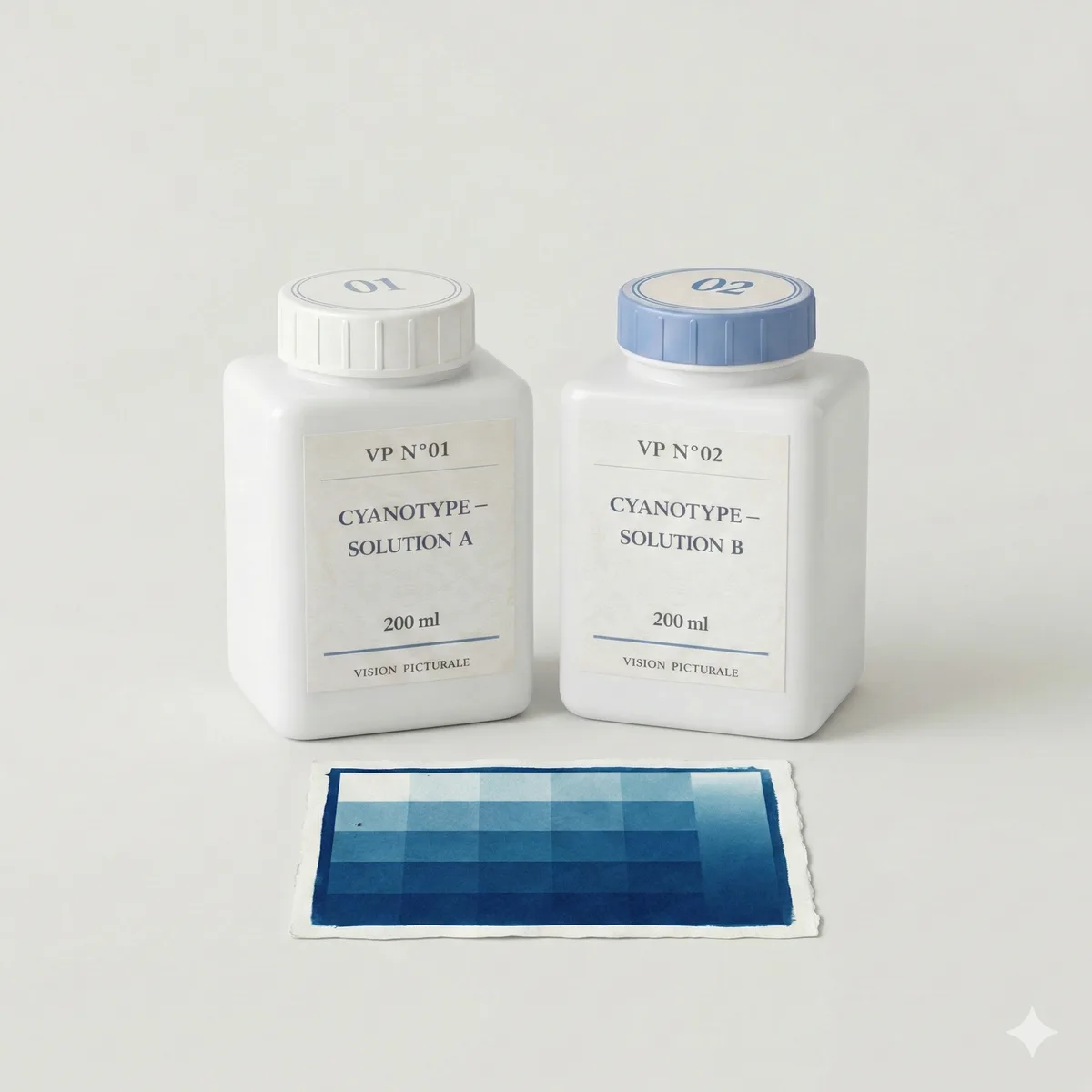
1. Cyanotype
Cyanotype is by far the most accessible alternative process. It produces prints in deep Prussian blue on white paper. It remains a photographic-chemistry practice: consult the bottle safety information and the relevant SDS when available, then wear the indicated protection before starting.
Look: Blue monochrome. High contrast. Graphic aesthetic.
Difficulty: Easy. Perfect for beginners.
2. Aquaprint (Gum Print — without bichromate)
Historical gum bichromate mixes gum arabic, pigment, and potassium bichromate. Vision Picturale reformulated this process as Aquaprint: the same painterly polychromatic result in a formulation without bichromate. Consult each component's safety information and the relevant SDS when available before use.
Look: Soft colors, painterly watercolor texture. Highly customizable.
Difficulty: Intermediate. Multiple passes needed for color work.
→ Read the full article: gum bichromate and Aquaprint, without dichromate
3. Bromoil
Bromoil starts with a silver gelatin print that is bleached to remove the silver, then re-inked with oil paint. The result is a print of incomparable tactile richness, close to lithography.
Look: Rich, textured black and white with a powerful graphic presence.
Difficulty: Advanced. Demands a good command of inking.
→ Read the full article: bromoil, without the bichromate bleach
4. Carbon Print
Carbon printing is one of the most permanent processes. It uses pigment mixed with gelatin and bichromate. The result has unparalleled stability and extraordinary shadow depth.
Look: Black and white or color. Exceptional depth.
Difficulty: Advanced. Requires a transfer onto the final paper.
→ Read the full article: carbon printing, without the dichromate
5. Resinotype
The resinotype is a variant of the carbon process using a photopolymer resin. It yields highly detailed prints on varied substrates (paper, wood, fabric).
Look: Very high definition. Works on many substrates.
Difficulty: Intermediate to advanced.
→ Read the full article: resinotype, without bichromate or solvent
6. Van Dyke Brown
Van Dyke Brown produces elegant warm brown prints. The chemistry, based on iron salts and silver nitrate, is very easy to use. It's the ideal alternative to cyanotype for those who prefer warm tones.
Look: Warm sepia brown. Very photographic.
Difficulty: Easy to intermediate. No Vision Picturale kit: included here as a reference point.
7. Gumoil
Gumoil combines the principle of gum bichromate with oil-based re-inking. It yields prints of remarkable expressive power, with deep blacks and subtle nuance.
Look: Expressive, painterly, highly customizable.
Difficulty: Advanced. No Vision Picturale kit: included here as a reference point.
8. Platinum/Palladium
Platinum printing is the noblest process in photography. It uses platinum salts (or palladium, which is less expensive) and produces prints of absolute permanence with an unmatched range of grays. It is the benchmark process for collectors and museums.
Look: Soft grays, exquisite tonal range. A print made to last forever.
Difficulty: Intermediate. Expensive chemistry. No Vision Picturale kit: included here as a reference point.
9. Salted Paper
Salted paper is one of the very first processes in the history of photography (1830s). The paper is soaked in salt, then in silver nitrate. The result is a print with warm brown tones, slightly soft-focus and deeply poetic.
Look: Reddish brown, slightly matte, distinctly antique.
Difficulty: Easy to intermediate. No Vision Picturale kit: included here as a reference point.
Comparison table: the 9 processes
| Process | Historical toxic salt | VP reformulation | Difficulty | Look |
|---|---|---|---|---|
| Cyanotype | Two iron-salt solutions. | VP formulation without bichromate. Consult every bottle's safety information and the relevant SDS when available; VP N°01 can cause skin irritation. | Easy. Perfect for beginners. | Blue monochrome. High contrast. Graphic aesthetic. |
| Aquaprint (gum print — without bichromate) | Bichromate in the historical formula. | Aquaprint: VP formulation without bichromate. The VP N°03 developer is harmful if swallowed and skin contact must be avoided; consult the safety information and the relevant SDS when available. | Intermediate. Multiple passes needed for color work. | Soft colors, painterly watercolor texture. Highly customizable. |
| Bromoil | A (copper) bichromate bleach bath applied to a silver gelatin print — historically the most toxic step of the process, along with copper sulfate. | VP bromoil with no silver bleaching and no copper sulfate: gelatin matrix + VP N°03 developer, foam-roller inking with black Charbonnel intaglio ink. | Advanced. Demands a good command of inking. | Rich, textured black and white with a powerful graphic presence. |
| Carbon print | Bichromate (potassium dichromate) sensitizing the pigmented gelatin — hexavalent chromium classified CMR, the shared toxic point of historical pigment processes. | VP reformulation removing potassium bichromate from the historical protocol. Two boxes: Carbon Mono — Museum Black and Carbon CMYK — Deep Colour. Multi-century archival permanence, dMax above 2.4. | Advanced. Requires a transfer onto the final paper. | Black and white or color. Exceptional depth. |
| Resinotype | Dichromate plus solvent in the historical process (Namias, 1920s). | VP version without bichromate: consult each component's safety information and the relevant SDS when available before use. | Intermediate to advanced. | Very high definition. Works on many substrates (paper, wood, fabric). |
| Van Dyke Brown | No CMR salt flagged in the guide — chemistry based on iron salts and silver nitrate, described as very easy to use. | Status: already relatively safe per the guide (iron salts + silver nitrate); no VP reformulation or kit in the catalogue. The ideal alternative to cyanotype for warm tones. | Easy to intermediate. | Warm sepia brown. Very photographic. |
| Gumoil | Built on the gum bichromate principle (bichromate, a CMR chromium salt); the historical protocol also used an aggressive petroleum solvent. | VP gumoil with no bichromate and no aggressive petroleum solvent: ground oil pigments incorporated into pre-sensitized gum (sensitizer), standard Aquaprint exposure. | Advanced. | Expressive, painterly, highly customizable. Deep blacks and subtle nuance. |
| Platinum/Palladium | No toxic salt flagged in the guide — platinum or palladium salts, unalterable noble metals. | Status: no VP reformulation or kit in the catalogue — the sticking point is the cost of the chemistry (palladium is less expensive than platinum). The benchmark process for collectors and museums, with absolute permanence. | Intermediate. Expensive chemistry. | Soft grays, exquisite tonal range. A print made to last forever. |
| Salted Paper | No toxic salt flagged in the guide — the paper is soaked in salt, then in silver nitrate (an 1830s process). | Status: no VP kit in the catalogue; one of the very first processes in the history of photography (1830s). | Easy to intermediate. | Reddish brown, slightly matte, distinctly antique. |
How to choose your first process?
If you're a beginner, start with cyanotype for its simple gesture and spectacular blue. If you want color and a painterly approach, try Aquaprint, Vision Picturale's bichromate-free gum formulation. In both cases, read the product-specific safety information, consult the relevant SDS when available, and wear the indicated protection. For the most permanent and noble prints, aim for platinum/palladium.
Tristan Sidem & Raphaël Lebas de Lacour — Vision Picturale